

Welcome back to our final article to discover more about the spirituality of truth. What did Jesus actually say about truth? In a world filled with competing ideas, shifting opinions, and personal interpretations, this question feels more relevant than ever. Rather than relying on assumptions or secondhand summaries, let’s go directly to His words. As we explore the New Testament, we’ll trace how Jesus spoke about truth—where it comes from, how it shapes our lives, and why it ultimately matters.
Jesus Proclaims the Source of Truth
Let’s jump right into some of Jesus’ statements about truth. In Jesus’ prayer for his disciples, he prays, “Sanctify them by the truth; your word is truth.” (John 17:17). In his prayer, Jesus reveals that God is the ultimate source of truth, and the vehicle in which God communicates it to us is through his Word, the Bible.
In an encounter with the crowds, Jesus remarked, “If you hold to my teaching, you are really my disciples. Then you will know the truth, and the truth will set you free.” (John 8:31-32) In this exchange with the crowds, Jesus is encouraging them to hear and obey his teachings to prove their worth as disciples. A promise follows that if they did what he commanded them, they would be filled with spiritual truth, a truth that would free them from the chains of Satan and sin. Indirectly, Jesus taught that spiritual truth comes from following him!
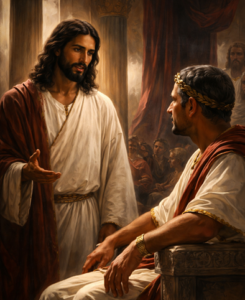
In another confrontation where Jesus reveals the source of spiritual truth in an exchange with Pontius Pilate, we read, “You are a king, then! ” said Pilate. Jesus answered, “You say that I am a king. In fact, the reason I was born and came into the world is to testify to the truth. Everyone on the side of truth listens to me.” (John 18:37). What a powerful response that apparently flew over Pilate’s head. Jesus couldn’t be more direct in declaring his purpose: to bear witness to the spiritual truth for all of humanity. In other words, Jesus proclaimed that he was the source of the spiritual truth that came from God.
 Finally, during the Last Supper, Jesus reveals to his disciples that the Holy Spirit is the source of truth, which would be fully realized after his departure. Jesus proclaims, “When the Advocate comes, whom I will send to you from the Father—the Spirit of truth who goes out from the Father—he will testify about me. And you also must testify, for you have been with me from the beginning” (John 15:26). In this passage we clearly realize that this truth Jesus refers to is the truth from the Holy Spirit that comes from the Father. This is not a subjective, man-created truth designed to appease the hearts of sinners but an absolute spiritual truth that the Holy Spirit speaks into the soul of every Christian.
From these aforementioned biblical references, Jesus gives us an understanding of the source of this spiritual truth as originating from the triune God, Father, Son, and Holy Spirit. This is God’s absolute truth that sanctifies us, restores our relationship with God, and gives us hope of eternal life.
Jesus is the Truth
But there’s an even deeper layer to this truth that we haven’t discovered yet. It is expressed in the most powerful and insightful statement Jesus revealed about his own nature regarding truth in the Gospel of John. While talking to his disciples about departing from them and from the world, the disciple Thomas remarked, “… Lord, we don’t know where you are going, so how can we know the way?” (John 14:5). Thomas and the other disciples thought Jesus was referring to a physical location he would be going to. But as in many times before, Jesus’ response was more spiritual in nature. Jesus answered, “I am the way and the truth and the life. No one comes to the Father except through me.” (John 14:6) Jesus’ statement strikes at the foundation of our faith as Christians. As the Son of God, only Jesus is our gateway to the Father; as the possessor of truth, he is the embodiment of truth itself!
Augustine of Hippo, one of Christianity’s early church fathers, described ‘truth’ this way: “Where I found truth, there found I my God, the Truth itself.”[1] Augustine believed that objective truth was part of the essence of God the Father and the Son, in the same way Love is the expression of God.
Merrill C. Tenney, professor of Bible and Theology, Emeritus, at Wheaton College, wrote the following commentary about the nature of Jesus: “He is the way to the Father because only he has an intimate knowledge of God unmarred by sin. He is the truth because he has the perfect power of making life one coherent experience irrespective of its ups and downs. He is the life because he was not subject to death but made it subject to him. He did not live with death as the ultimate end of his life; he died to demonstrate the power and continuity of his life. Because he is the way, the truth, and the life, he is the only means of reaching the Father.”[2]
As Christians, How Do We Respond?
I believe we need to respond in two major ways. First, to be aware of the subjective truth that exists around us. The apostle Paul’s instruction to Timothy is grounded in wise counsel and guidance that applies to us today. Paul encouraged Timothy to be alert to the false truths that resided in many areas of his culture and to be prepared to correct, rebuke, and encourage others lovingly about the objective truth that comes from Christ. Paul warned Timothy as well as us: “For the time will come when people will not put up with sound doctrine. Instead, to suit their own desires, they will gather around them a great number of teachers to say what their itching ears want to hear. They will turn their ears away from the truth and turn aside to myths. But you, keep your head in all situations, endure hardship, do the work of an evangelist, and discharge all the duties of your ministry.” (2 Timothy 4:3-5)
Secondly, as Christians we are called to not only be aware of our culture’s influences and deceptions that go against the truths of God but also to lovingly proclaim God’s truths to those He has provided in our lives. We are called to be the ‘light’ of the world, shining the light of truth whenever we can. The apostle Paul encouraged the Christians in Corinth that, “We demolish arguments and every pretension that sets itself up against the knowledge of God…” (2 Corinthians 10:5a). I encourage you to be steadfast in defending your faith and the spiritual truth you are committed to follow.
Conclusion: What is Truth?
As we reflect on all we’ve explored in this series about the meaning of truth, we are left with a firm and grounded understanding—one that not only informs the mind but anchors the soul. We’ve learned about our culture’s deception and the consequences of subjective truth and the challenge it presents to God’s objective truth in every facet of our lives. We’ve learned that God’s truth comes from our Heavenly Father, Jesus, and the Holy Spirit. We’ve come to realize that real truth is not created by people or our culture but created and revealed by God himself. The search for truth ultimately leads us beyond philosophy to the person of Christ. Truth is not only a proposition to be studied but a person to be known.
As we wrap up this series on the many perceptions of truth, my prayer is that your faith is encouraged and strengthened by what we’ve discovered—and by the reminder that Jesus Christ is our rock, our source of truth and salvation, and the anchor for our lives.
ENDNOTES
[1] Augustine of Hippo, Confessions, Book X, Chapter 24, “He Who Finds Truth, Finds God,” trans. R. S. Pine‑Coffin (London: Penguin Books, 1961), 178.
[2] Merrill C. Tenney, “John,” in The Expositor’s Bible Commentary, vol. 9, ed. Frank E. Gaebelein (Grand Rapids, MI: Zondervan, 1981), 144.