
In the past, my love for both the Scriptures and science often challenged me intellectually, as I tried to reconcile conflicts that occasionally surfaced between the two disciplines. That changed when I began to think more deeply about how our society interprets ideas from these subjects and what precautions are necessary to form more accurate interpretations. The last article spoke at length about some of these precautions. In this final article we will investigate some of the convergence and controversies that exist between these two disciplines by examining two major topics of contention: our universe’s perfect balance of forces and their constants of nature and, secondly, the structure of the DNA molecule and its role in storing genetic information.
Forces and Constants of the Universe
What scientists and theologians can agree on is that there exist four identifiable forces and 20 to 30 fundamental constants that appear finely tuned. These four forces are
- Gravitational force
Governs attraction between masses; shapes galaxies, stars, planets, and allows stable orbits.
- Electromagnetic force
Responsible for electricity, magnetism, chemistry, light, and atomic structure.
- Strong nuclear force
Holds protons and neutrons together in atomic nuclei; without it, atoms could not exist.
- Weak nuclear force
Responsible for radioactive decay and nuclear fusion processes in stars.
Some of the more familiar (at least among the scientific community) and significant fundamental constants identified include:
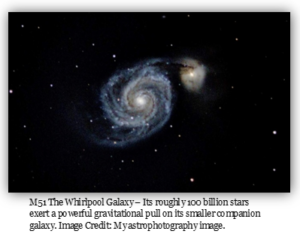
- Strength of gravity
- Strength of the electromagnetic force
- Strong nuclear force coupling constant
- Weak nuclear force coupling constant
- Cosmological constant (dark energy)
- Ratio of electron mass to proton mass
- Speed of light
- Planck constant
- Fine-structure constant
- Initial entropy of the universe
Contemporary scientists have recognized that these forces and constants of nature are very specifically tuned, making life on earth possible. Stephen Hawking, a theoretical physicist & cosmologist, in his book, A Brief History of Time: From the Big Bang to Black Holes, stated, “The laws of science, as we know them at present, contain many fundamental numbers, like the size of the electric charge of the electron and the ratio of the masses of the proton and the electron… The remarkable fact is that the values of these numbers seem to have been very finely adjusted to make possible the development of life.”[1]
John D. Barrow and Frank J. Tipler, a team of cosmologists, also remarked about the finely tuned state of our nature’s forces. In their book, The Anthropic Cosmological Principle, they wrote, “If the electromagnetic force were stronger or the strong nuclear force a little weaker, or both, then biologically essential [atoms] like carbon would not exist. The existence of [life] hinges upon this ‘coincidence.’”[2]
So, where is the contention?
Debate Between the Disciplines
The debate between the Bible and science seems to be about how to interpret this fine-tuning, not whether it exists. Many scientists appear to gravitate toward an argument where unknown nature forces or various multiverse scenarios are the cause for this perfect state of our universe. A natural progression of our universe could negate the need for a creator. In other words, if everything about the universe—from its origin to its structure—can be explained by impersonal natural laws, then belief in a creator becomes redundant.
On the other hand, Christian theologians favor the explanation of a superintelligent designer as the cause of our fine-tuned universe. And if this designer (God) orchestrated the universe with such precision, then he could have also inspired the writings of the Bible as a reliable pathway to himself.
One strong argument in favor of intelligent design is that no known scientific laws require the universe to be the way it is, and the chance of it being the way it is without a designer seems to be mathematically impossible. Martin John Rees, Baron Rees of Ludlow, is a highly respected British cosmologist and astrophysicist. In his book titled Just Six Numbers: The Deep Forces That Shape the Universe, Rees explains that small variations in several fundamental constants would make life impossible and that physics does not currently explain why these constants have their observed values.[3] Scientists cannot account for why there should be any laws of physics, and it is logically inconsistent to suggest that physics made up its own laws.[4]
 Design of DNA
Another fascinating field of research where critics believe the Bible and science seem to disagree is molecular biology and biochemistry, particularly in the study of the structure of DNA. These molecules are in every organic lifeform on earth and are extremely complex in their design and function and not fully understood.
In humans, DNA molecules have the following interesting properties:
- Every human’s DNA is 99% the same. Only 1% makes us different.
- Almost every cell in the human body has DNA in its nucleus.
- Inside that nucleus is your complete genome, or DNA (~3 billion base pairs).
- This nucleus DNA holds the instructions for building and maintaining the body.
- Mature human red blood cells do not have a nucleus or DNA.
In a lecture a number of years ago, Lee Strobel, who is a Christian author and former investigative journalist, presented an argument for human creation by God as described in the Bible. His rationale was based on the complexity of DNA strand design in our own bodies and every living organism. He stated that every strand of DNA in each of the 60 trillion cells of your body (with the exception of red blood cells) contains all the instructions for creating you. DNA in a cell in your eye is exactly the same as DNA in a cell in your liver or stomach. The difference is which parts of the DNA are active and which are inactive.
A single DNA molecule is 6 feet long but only 50 trillionths of an inch wide. If placed end to end, all the DNA molecules in your body would reach from Earth to the Sun and back 360 times. Evolutionists might be able to present an argument for the evolution of matter and energy in our universe from a simpler form into a more complex form, but they have no logical explanation for the evolution of these complex data-driven instructions that provide a master blueprint for building, running, and maintaining every living organism. Such a design can only be explained as originating from a supernatural designer.[5]
Conversely, some biologists contend that natural selection is responsible for the emergence of the complex instructions encoded in DNA, which guide the construction, operation, and maintenance of living organisms. 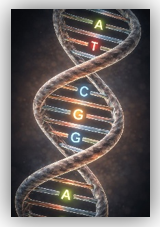 One such scientist is Richard Dawkins, an evolutionary biologist who once stated, “When I say that human beings are just gene machines… natural selection… is best seen at the gene level… living organisms and their bodies are best seen as machines programmed by the genes to propagate those very same genes.”[6]
In my personal experience as a former software engineer in the aerospace industry, my colleagues and I would frequently use the saying, “Garbage in, garbage out.” This idiom implies that a programmer must input a well-designed sequence of code for the resulting program to function logically and correctly and achieve its intended purpose. If the input sequence of code was poor in design or worse, random, the resultant program output was always garbage. But when skeptics examine DNA instructions, they often view it as the result of random natural processes and chance, not as the product of creative design. The actions of nature can create patterns, but there is no science whatsoever that shows nature can create intelligence or organized information on its own.
Another major part of this debate surrounding the DNA molecule originates from the fact that humans share approximately 98–99% DNA similarity with chimpanzees, and therefore scientists strongly believe in a common biological ancestry between humans and chimpanzees. This, they believe, supports their argument for natural selection and evolution. They do not accept the literal reading of Genesis 1-2, which speaks about Adam being created apart from other animals. Just because God created mankind from the same ingredients as other lifeforms on earth doesn’t mean he created them alike in all aspects. Instead of looking at their similarities, we should be looking at their differences physically, metaphysically, and spiritually.
In addition, research in this field of science infers evolution and history from genetic patterns, whereas the Bible speaks of God who created our complex biological structures and created mankind in his own image. Therefore, God fashioned certain aspects of mankind comparable to himself. This belief is founded on the passage in Genesis that states, “Then God said, ‘Let us make mankind in our image, in our likeness, so that they may rule over the fish in the sea and the birds in the sky, over the livestock and all the wild animals, and over all the creatures that move along the ground.’ So God created mankind in his own image, in the image of God he created them; male and female he created them.” (Genesis 1:26-27)
A number of scientists who are theistic perceive the creation of DNA in harmony between science and faith, viewing the DNA code as both scientifically real and theologically significant. One such scientist is Francis S. Collins, a physician-scientist who discovered the genes associated with a number of diseases and led the Human Genome Project. Collins remarked in this book, The Language of God: A Scientist Presents Evidence for Belief, the following: “The God of the Bible is also the God of the genome. He can be worshipped in the cathedral or in the laboratory. His creation is majestic, awesome, intricate and beautiful—and it cannot be at war with itself.”[7]
Conformity of the Bible and Science
We can find many examples where the Bible displays harmony with physical reality. But it requires an open mind and acceptance of a metaphysical realm that cannot be seen, measured, or tested. The scientific process must be recognized as a tool that is limited to answering questions of ‘how’ things work in our physical realm, such as the fields of physics and biology. Questions in the metaphysical or spiritual realm address the “why” outside our physical universe, such as why anything exists at all, or why God created us. These are questions that cannot be answered by measurement or resolved by any of our senses. Science’s giants, such as Isaac Newton and Johannes Kepler, studied both the physical and biblical realms and found harmony between them.
As mentioned in the previous article, much of what is discovered through the scientific process should be considered a ‘work in progress’ to ultimately understand the truths of our world. We cannot assume that the latest scientific evidence is always absolute truth. Meanwhile, we must also consider God’s Word as primarily a revelation from God about himself and his plan for mankind, not a modern scientific textbook citing every physical formula and description of how our universe works. The Bible must be recognized as a collection of 66 books with a diverse set of literary styles, such as historical narrative, poetry, wisdom literature, life’s practices, and prophetic symbolism. Therefore, exegetical wisdom and discernment must be used to interpret it properly. Let me provide you with a few examples of the harmony between these two disciplines where they overlap in the area of science. Note the correctness but lack of precision in the scripture’s descriptions.
In Isaiah 40:22, the prophet speaks of God as sitting “above the circle of the earth.” This indicates knowledge as to the shape of the planet almost 20 centuries before Columbus. (See also Ecclesiastes 1:6, “The wind blows to the south and turns to the north.”)
Again, in Isaiah 51:6, the author writes, “The earth will wear out like a garment and its inhabitants die like flies. But my salvation will last forever, my righteousness will never fail.” (See also Romans 8:20, Psalm 102:25-26, and Hebrews 1:10-11). These passages speak about the temporary nature of the universe and how it will come to an end, consistent with the Law of Entropy.
Another example of the Bible agreeing with our physical reality in nature is found in Job 26:7, speaking of God, “He spreads out the northern skies over empty space; he suspends the earth over nothing.” Hindu scripture teaches the earth rests on the back of an elephant. Chinese mythology (along with some Native American, Polynesian, and Asian traditions) teaches that the world sits on the back of a turtle. But the revelation by God to an ancient man was that God suspends the earth in space.
Finally, in Genesis 1:1, we find, “In the beginning God created the heavens and the earth,” which is consistent with current cosmological theories that our universe had a beginning and is not eternal.
The Bible vs. Science Debates
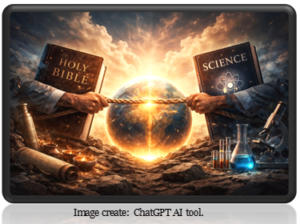 Let’s now pivot our conversation to the debates and controversies surrounding the Bible vs. science. They both appear to proclaim the ‘real truth’ in their teachings. But there is only one physical and biblical reality for a given situation. The table below lists some of the more notable “Bible vs. Science” disputes that have caught the attention of our modern society.
Table of Common Bible vs. Science Disputes
Topic | Science Perspective | Religious Perspective |
1. Origin of the Universe | The universe began with the Big Bang ~13.8 billion years ago, driven by natural laws. | God created the universe intentionally; views range from literal six-day creation to theistic evolution. |
2. Age of the Earth | Earth is about 4.54 billion years old based on radiometric dating. | Young-earth views are thousands of years; old-earth views accept scientific dating and affirm divine creation. |
3. Evolution vs. Creation | Life evolved through natural selection and genetic change. | God created life; from special creation of each kind to God-guided evolution. |
4. Origin of Humanity | Humans evolved from earlier hominins over millions of years. | Humans were specially created by God, made in His image; some accept evolution as part of God’s process. |
5. Miracles | Natural laws are universal and unbroken; miracles are not scientifically testable. | God can override natural laws; miracles are historical, purposeful acts revealing God’s power. |
6. Resurrection of Jesus | Scientifically impossible; seen as legend or symbolic. | The central historical event of Christian faith: literal bodily resurrection by divine power. |
7. Reliability of Scripture | Ancient texts are human products reflecting cultural context and error. | Scripture is divinely inspired, authoritative, and trustworthy in what it teaches. |
8. Bioethics (e.g., embryonic stem cells, cloning) | Focus on technological possibilities, potential benefits, and medical outcomes. | Human life has God-given dignity from conception; many procedures raise moral concerns. |
9. Consciousness & the Soul | Consciousness arises from brain processes and physical mechanisms. | Humans possess an immaterial soul given by God; consciousness transcends the purely physical. |
10. End of the World / Cosmology | The universe will end through heat death, collapse, or other natural processes. | God will ultimately bring history to its intended conclusion as described in Scripture. |
This table is intended to provide you with a sample of controversies between these two disciplines. Unfortunately, addressing all the topics is beyond the scope of this article. But there are many reputable authors who have written books about these scientific topics and their arguments and counterarguments. Refer to the endnotes for a short list of these authors.[8]
Where do we go from here?
As we end this series, let us not forget our goal to answer the title question, Is the Bible a reliable pathway to God? In pursuit of this goal, take a moment to review the key evidence that we have uncovered through our past articles.
Self-Claims
- We read that the Bible claimed it was God who inspired the prophets and authors to write the Scriptures, representing God’s revelations.
- We learned the Bible has declared itself to be beneficial for teaching, rebuking, correcting and training in righteousness.
- We discovered that the Bible claims to be more than text in a book; it is alive and transformative in the lives of its readers.
- We learned that the Bible claims to be more than just the author’s inspired words but the very words of God, speaking to us directly.
- Finally, we heard that throughout the ages, the Bible professes to alter the lives of countless people by leading them to God.
Old and New Testaments Preserved
- We found that, through the practice of textual criticism, the biblical text has been preserved with a remarkably high degree of accuracy—estimated by some textual critics at over 99 percent—relative to the original manuscripts.
- Through centuries of transcription, the Scriptures have been preserved, and today we possess a Bible with only minor textual changes from the original with no changes to its core doctrines or theological truths.
- We learned that the discovery of the Dead Sea Scrolls provided a treasure trove of manuscripts of the Old Testament that substantiated the reliability of the more recently discovered Leningrad Codex.
- The number of existing New Testament manuscripts far exceeds that of other ancient secular Greek and Roman works, which scholars regard as substantially faithful to their original texts.
Archaeological Reliability
- We read that the Tel Dan Stele, Ketef Hinnom Scrolls, and countless other archaeological artifacts clearly supported some of the historical accounts of the Old Testament’s people and events.
- We discovered that of the thousands of archaeological discoveries, not a single one has contradicted either the events or people recorded in the Scriptures.
Prophetic Reliability
- We learned that foretelling is a prophetic message from God to a prophet that reveals insight into a future time, event, or place, which is spoken to declare to others a prediction of what is to come.
- We studied that predictive prophecy has two purposes: to affect the conduct of the hearer and to build faith when the prophecy is fulfilled.
- It was calculated that the mathematical odds of fulfilling 48 such prophecies about the actions of Christ are 1 in 10**157, more than all the electrons in the universe. Christ was referred to by over 300 Messianic prophecies, which biblical scholars claim were all fulfilled.
- There are over 1,800 predictive prophecies in the Bible, of which 1,500 have already been fulfilled.
Scientific Interpretation, Convergence and Controversy
- We were instructed about the reasons for observing scientific and biblical precautions as they relate to events or behaviors that intersect the two disciplines.
- We were taught that physical reality is what actually exists in the material universe, and biblical reality is what is truthfully revealed in the Bible according to God’s revelation. Therefore, physical reality is always congruent with biblical reality.
- We read about past mistakes the Church and scientific community have made throughout history when the scientific and biblical precautions were not followed.
- We studied the Kalam Cosmological Argument, which provides a logical argument for the creation of the universe and the existence of God.
- We considered the forces of nature to appreciate that these fine-tuned forces can only be explained as being designed, not evolved.
- We examined the complexity of the DNA molecule and the intricate arrangement and large quantity of information contained in each DNA strand. This information could not have evolved naturally over any length of time.
- We examined the conformity between the Bible and science as we read through multiple biblical verses that described the nature of our world.
So Where Does All This Data Leave Us?
For starters, there’s certainly a lot of information to digest! Given the data we’ve uncovered from the Bible’s self-claims, its preservation through history, and archaeological data, there exists strong evidence for the integrity of the Scriptures as a trusted source for historical information. Regarding the prophetic data, especially the predictive prophecies, it is challenging to explain away the number of Messianic prophecies that were written centuries before Jesus’ birth that foretold (some in striking detail) the events related to his life and death. And finally, we have scientific data, which reveals our nature’s wonders, such as the creation of the universe with its fine-tuned forces and the structure and information of the DNA molecules that appear to have been designed by a creator, not produced by natural evolution. In the judgment of the author of this series, the evidence overwhelmingly affirms the Bible’s reliability as a faithful revelation from God and as a reliable pathway to God.
If you are a Christian…
I hope this article series has strengthened your faith and confidence in the reliability and truthfulness of God’s Word and given you a foundation for defending your faith as you share it with others. Remember that God has given us an intellect and wisdom to understand what we believe and not to accept it blindly. Rest assured that you can trust the Bible as a reliable pathway to God for yourself and for others.
I am reminded by what the apostle Paul wrote, “All Scripture is God-breathed and is useful for teaching, rebuking, correcting and training in righteousness…” (2 Timothy 3:16) The Bible is a collection of God’s thoughts revealed through spoken and written words that are expressed through a variety of literary genres for all generations. Will Graham, Billy Graham’s grandson, made the following comments about the permanence of the Word of God: “Though circumstances, relationships, politics, and culture move, the Bible is everlasting—a firm foundation. It lights our path and meets our needs. Commit to filling your soul with the Word of God and allowing Him to guide your steps.”[9]
Finally, Christians need not be fearful of exploring new scientific theories about God’s created nature, particularly those that attempt to explain how his handiwork operates in its astonishing beauty. R.C. Sproul, in his paper titled The Christian and Science, stated this point most eloquently: “He should not be afraid that a new discovery of something that is true will destroy his foundation for truth. If our foundation for truth is true, all other truth can only support it and enhance it. It can’t destroy it.”[10]
If you are still skeptical or a non-Christian
I thank you for taking this journey with me, and I hope that this evidence has caused you to reconsider the reliability of the Bible as a pathway to God. You are now faced with the most important decision you will ever make. Will you continue this journey to get to know God more deeply and pursue a more serious study of this topic? I encourage you to take the next step by exploring some of the more insightful books referenced in the endnotes throughout these articles. Also read what the Bible has to say to you. Start with the Gospel of John and judge for yourself whether the Bible provides you with a pathway to God!
ENDNOTES
[1] Stephen W. Hawking, A Brief History of Time: From the Big Bang to Black Holes (New York: Bantam Books, 1988), 125.
[2] John D. Barrow and Frank J. Tipler, The Anthropic Cosmological Principle (Oxford: Oxford University Press, 1986).
[3] Rees, Martin. Just Six Numbers: The Deep Forces That Shape the Universe. New York: Basic Books, 2000.
[4] Portions of this section are adapted from my previously published small group series by Robert A. Mimiaga and Lew Davies, “Can You Really Trust the Bible?” (New Hope Church, Bend, OR, 2011)
[5] Lee Strobel, Evidence of God from DNA by Lee Strobel.flv, YouTube, Apr 21, 2010, https://www.youtube.com/watch?v=iLCBJLyxxvM
[6] Dawkins, Richard. Interview by PBS Faith & Reason. Accessed January 6, 2026.
[7] Francis S. Collins, The Language of God: A Scientist Presents Evidence for Belief (New York: Free Press, 2006).
[8] A short list of reputable author’s writings about the Bible and Science.
Norman L. Geisler and Kerby Anderson, Origin Science: A Proposal for the Creation–Evolution Controversy (Grand Rapids: Baker Book House, 1987).
Norman L. Geisler and Frank Turek, I Don’t Have Enough Faith to Be an Atheist (Wheaton, IL: Crossway, 2004).
William Lane Craig, Reasonable Faith: Christian Truth and Apologetics, 3rd ed. (Wheaton, IL: Crossway, 2008).
William Lane Craig and J. P. Moreland, eds., The Blackwell Companion to Natural Theology (Malden, MA: Wiley-Blackwell, 2012).
J. P. Moreland, Christianity and the Nature of Science: A Philosophical Investigation (Grand Rapids: Baker Book House, 1989).
Hugh Ross, The Creator and the Cosmos, 4th ed. (Covina, CA: Reasons to Believe, 2018).
Hugh Ross, A Matter of Days: Resolving a Creation Controversy, 2nd ed. (Covina, CA: Reasons to Believe, 2015).
John C. Lennox, God’s Undertaker: Has Science Buried God? (Oxford: Lion Books, 2009).
John C. Lennox, Seven Days That Divide the World: The Beginning According to Genesis and Science (Grand Rapids: Zondervan, 2011).
Lee Strobel, The Case for a Creator (Grand Rapids: Zondervan, 2004).
Josh McDowell, The New Evidence That Demands a Verdict (Nashville: Thomas Nelson, 1999).
Alvin Plantinga, Where the Conflict Really Lies: Science, Religion, and Naturalism (Oxford: Oxford University Press, 2011).
C. S. Lewis, Miracles: A Preliminary Study (London: Geoffrey Bles, 1947).
Henry M. Morris, The Genesis Record: A Scientific and Devotional Commentary on the Book of Beginnings (Grand Rapids: Baker Book House, 1976).
Henry M. Morris and John D. Morris, The Modern Creation Trilogy (Green Forest, AR: Master Books, 1996).
[9] Will Graham, “God’s Word: An Everlasting Foundation,” Decision: The Evangelical Voice for Today, Billy Graham Evangelistic Association, October 2025.
[10] R.C. Sproul, The Christian and Science, Ligonier.org, https://learn.ligonier.org/articles/christian-and-science#user-content-fn-1