
In our last article, we discussed the textual preservation of the Old Testament manuscripts. It was amazing to see the evidence that revealed the degree of certainty with which these manuscripts were textually preserved. But what about the preservation of the New Testament books? In this article we will draw our attention to the New Testament manuscripts and discover how textual criticism methods are applied to recreate their original wording and to evaluate the preservation of these writings. We will also compare the availability of the New Testament’s manuscripts with widely accepted ancient secular works.
What methods exist to determine the original wording of ancient manuscripts?
Fortunately, textual critics employ a variety of methods to determine the original wording of ancient secular as well as the New Testament manuscripts. When evaluating the ancient manuscripts, the textual critics attempt to identify variations between the original manuscripts and the current Bible content to show its characters, events, and places mentioned are consistent.[1]
Textual Criticism
The textual criticism process, which was briefly discussed in the last article, compares thousands of New Testament manuscripts in order to determine the original wording of the biblical texts.
In evaluating the New Testament manuscripts, this process focuses on the identification and removal of transcription errors in texts and manuscripts. In cases where the original manuscripts were written thousands of years ago, their preservation to this day is the result of a careful process of transcription, in which countless copies were produced through the centuries to safeguard their content.
The Bible is one such historical manuscript that has been preserved in this manner utilizing this process. For example, when an original letter, such as a New Testament letter from the apostle Paul, was sent to its addressed church, the church elders would periodically read it to the congregation and preserve the original papyrus manuscript. Eventually hand copies of the original letter were transcribed and sent to the surrounding Christian churches.[2]
Here is an explanation of how textual criticism is used to evaluate the preservation of the Bible. William Lane Craig is Emeritus Research Professor of Philosophy at Talbot School of Theology (my alma mater), who has written over thirty books on philosophy, theology, and apologetics. In 2016 Dr. Craig was named by The Buhler Report as one of the fifty most influential living philosophers.[3]
On Dr. Craig’s website, he was questioned about the accuracy of some of the New Testament’s earliest manuscripts that we possess, in which a gap of 20 to 200 years to the original manuscripts might have existed. In other words, couldn’t there still be a significant difference in content between the earliest manuscript found and the original texts? Dr. Craig replied, “The goal of the textual critic is not to discover the reading of the earliest manuscripts; rather, the goal of the textual critic is to compare all of the manuscripts we have in different families and traditions with a view toward reconstructing what the original text read. You can do this by seeing how the manuscripts have been copied, where copyist errors have crept in, and thereby establishing the wording of the original. So, for example, I heard an interview several years ago on “The Lutheran Hour” with Bart Ehrman, who was claiming that there were these hundreds of thousands of copyist errors that have been made in the manuscripts of the New Testament. And the radio interviewer said to him, “Well, then, what do you think the original text actually said?” And Ehrman said, “What do you mean?” And he said, “You’ve said there are all these errors that have crept in. What do you think the original text said?” And Ehrman said, “It said pretty much what we’ve got today.” And the fellow said, “But I thought you said all these errors have crept in?” And Ehrman responded, “Yes, but we’ve been able to reconstruct the original text.” So, for someone like an Ehrman, he recognizes that with about 99% accuracy we know what the original text of the New Testament read, and the uncertainty concerns merely trivialities.”[4]
Let me pause for a moment from this line of thought to mention that Bart Ehrman is a self-proclaimed ‘agnostic atheist’ who happens to be an expert in the textual criticism of the New Testament.[5] He is a well-known Bible detractor yet admitted in the aforementioned radio program that the New Testament manuscripts have been reconstructed with about 99% accuracy, and the uncertainty concerns are merely trivialities. That’s quite a bold statement in support of the textual preservation of the Bible.
Returning to our earlier point, there can always be slight differences between transcribed manuscripts due to the transcription process that was used through the ages. Because the original manuscripts no longer exist, scholars compare copies from different times and places, evaluate differences in wording, and weigh evidence such as age, geography, and context. In the case where there exists a difference in a word or grammar that cannot be resolved through this process, we may not know which is from the original document, but these are minor in substance and certainly of no consequence to the significant doctrinal theology or beliefs.
But what about the age of these manuscripts? Isn’t it fair to assume that the farther back in time an event was recorded, the less trustworthy it might be?
An Ancient Manuscript’s Critical Gap
In another interview, Dr. Craig responded to a similar question by clarifying that the critical gap of concern is not the gap between the time of the original event and today, but the period between when the original event occurred (Event) and the earliest surviving manuscript copies we possess that recorded the event (Evidence). Therefore, if the critical gap between the events and their supporting evidence is short, the time elapsed from those events to the present is irrelevant.
Dr. Craig also remarked that good evidence doesn’t become bad evidence simply because of the lapse of time. When we examine the evidence for the New Testament, we find that these accounts of Jesus’ life were recorded within the first generation following those events, when the eyewitnesses were still alive and had direct contact with those who had accompanied Jesus during his lifetime. Consequently, the New Testament has better sources for the life of Jesus of Nazareth than we do for most of the major figures of antiquity.[6]
Bibliographic Test
The Bibliographic Test is another method textual critics used to determine the accuracy of the original manuscript copies. This test is used to assess the preservation of ancient documents based on how faithfully a text has been transmitted over time. In this test, textual critics place a high value on how many manuscripts exist, the amount of time elapsed between the original writing and the earliest surviving copies, and how widespread the text was geographically.
Take a look at the following table that compares a number of secular manuscripts currently known to exist with the amount of currently discovered New Testament documents.
Comparative Manuscript Evidence: Secular Texts vs. New Testament
Author/Text | Original Date | Earliest Extant Manuscript | Date & Qty Manuscripts | Gap (years) | Notes |
Homer, Iliad | c. 750 BC | Venetus A (codex) | 10th century AD ~1,757 | ~1,650 | Only partial text survives before 10th c.; hundreds of manuscripts exist later.[7] |
Plato, Republic | c. 380 BC | Codex Oxoniensis Clarkianus 39 | 9th century AD ~7,000 | ~1,250 | Classical text transmitted via medieval manuscripts.[8] |
Caesar, Gallic Wars | c. 50 BC | Codex Parisinus Latinus 3864 | 9th century AD ~10 | ~850 | Gap is typical for Roman historical texts.[9] |
Pliny the Younger, Letters | c. 100 AD | Codex Laurentianus | 9th century AD ~20 | ~800 | Many letters survive in medieval manuscripts.[10] |
Sophocles, Oedipus Rex | c. 430 BC | Venetus A | 10th century AD ~193 | ~1,330 | Reconstructed from later manuscripts.[11] |
New Testament, Gospel of John (P66) | c. 90 AD | P66 | c. 200 AD ~100 leave fragments | ~100 | Very small gap compared to classical texts.[12] |
New Testament, Luke-Acts (P75) | c. 80–90 AD | P75 | c. 175–225 AD 85-145 leave fragments | ~85–145 | Contains large portions of Luke & Acts.[13] |
New Testament, Pauline Epistles (P46) | c. 50–60 AD | P46 | c. 175–225 AD 115-175 leave fragments | ~115–175 | One of the earliest near-complete collections of Paul’s letters.[14] |
Complete New Testament (Codex Sinaiticus) | c. 50–100 AD | Codex Sinaiticus | 4th century AD One copy | ~250–300 | One of the earliest complete manuscripts of the NT.[15] |
Complete New Testament (Codex Vaticanus) | c. 50–100 AD | Codex Vaticanus | 4th century AD One copy | ~250–300 | Oldest near-complete Bible manuscript.[16] |
All known New Testament fragments to complete codices | c. 50-100 AD | Papyri, uncials, minuscules, and lectionaries | c. ~100-1500 AD ~24,000 fragments to complete works | ~100-1400 | Most of the 24,000 manuscripts come from later periods.[17] |
This bibliographical test table compares the closeness of the New Testament’s oldest existing manuscripts to the date of its autographs (the original handwritten documents). Also note the number of existing copies of New Testament manuscripts in the last six rows, compared with the number of existing manuscripts of other ancient documents, such as Homer, Plato, Caesar, and Pliny the Younger, to the originals.
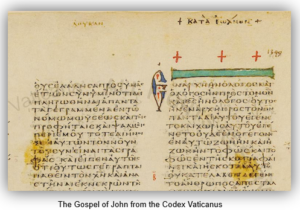 The New Testament is preserved in more than 5,800 Greek manuscripts,10,000 Latin manuscripts, and 9,300 manuscripts in various other ancient languages, including Syriac, Slavic, Ethiopic, and Armenian. There are approximately 300,000 textual variants among the manuscripts, most of them being the changes of word order and other comparative trivialities.[18] With the wealth of manuscript evidence for the New Testament, textual critics can compare texts against one another to identify and correct errors, which is the real value of such a large number of manuscripts.
In fairness, other arguments have been given by secular scholars challenging the Bible’s preservative credibility; however, none have achieved broad scholarly consensus or offered evidence widely regarded as decisive. When this evidence suggests the Bible is textually preserved, it’s not declaring that its narratives and events are proven true; rather, it’s declaring that the Bible possesses a high degree of confidence in what the original authors wrote.
Over the last few articles, we have come a long way to better understand the textual preservation of the Bible, but this doesn’t tell us anything about the historical reliability or the spiritual integrity of the text, and we are still far off from answering the question: Is the Bible a Reliable Pathway to God? Let’s see where the next article takes us as we draw our attention to examining the archaeological evidence of the Bible.
ENDNOTES
[1] Portions of this section are adapted from my previously published small group series by Robert A. Mimiaga and Lew Davies, “Can You Really Trust the Bible?” (New Hope Church, Bend, OR, 2011)
[2] Harry Y. Gamble, Books and Readers in the Early Church: A History of Early Christian Texts (New Haven: Yale University Press, 1995), p. 101 and E. Randolph Richards, ,i>Paul and First-Century Letter Writing: Secretaries, Composition, and Collection (Downers Grove, Ill.: InterVarsity Press, 2004), p. 217.
[3] “The 50 Most Influential Living Philosophers,” The Buhler Report, September 12, 2016, https://www.keithbuhler.com/philosophy/2016/09/12/most-influential-living-philosophers.html
[4] William Lane Craig, Reasonable Faith, Questions About Textual Criticism, Numbers, and the Deity of Jesus, May 09, 2022, https://www.reasonablefaith.org/media/reasonable-faith-podcast/questions-about-textual-criticism-numbers-and-the-deity-of-jesus
[5] Bart D. Ehrman, Why Doesn’t Bart Believe in God? YouTube video, 49:41. Posted March, 21, 2023, https://www.youtube.com/watch?v=e6DUD1KHEnk&t=18s
[6] William Lane Craig, Can We Trust The Bible Written 2000 Years Ago? YouTube, 100 Huntley Street, https://www.youtube.com/watch?v=reYBCz_kf1c
[7] West, M. L. Textual Criticism and Editorial Technique in the Homeric Epics. 2nd edition, 2013.
[8] Burnet, J. Plato: Euthyphro, Apology of Socrates, Crito, Phaedo, Phaedrus. Oxford, 1924.
[9] Ramsey, F. Caesar: Gallic War. Cambridge University Press, 1998.
[10] Radice, B. Pliny the Younger: Selected Letters. Penguin, 1969.
[11] Campbell, D. A. Greek Lyric Vol. 2. Harvard University Press, 1992.
[12] Comfort, P. W., & Barrett, D. P. The Text of the Earliest New Testament Greek Manuscripts. 5th ed., 2019.
[13] Metzger, B. M., & Ehrman, B. D. The Text of the New Testament: Its Transmission, Corruption, and Restoration, 4th ed., 2005.
[14] Comfort, P. W., & Barrett, D. P., 2019.
[15] Tischendorf, C. The Codex Sinaiticus. 1862–1869.
[16] Skeat, T. C. The Codex Vaticanus in the British Museum. 1938.
[17] The ~24,000 manuscripts include everything from tiny scraps to complete codices.
Most of the 24,000 manuscripts come from later periods (medieval uncials and minuscules), which preserve the text in large quantities and allow for detailed textual criticism.
[18] Wallace, Daniel. “The Majority Text and the Original Text: Are They Identical?” Archived from the original on 3 December 2013. Retrieved 23 November 2013.
Westcott and Hort (1896). The New Testament in The Original Greek: Introduction Appendix. Macmillan. p. 2. Retrieved 23 November201 3. The New Testament in the Original Greek.