
For those who believe in God’s existence, much thought has been devoted to His nature and character—who He is and what He is like. But what do we really know about God? Does God think like we do? Does he give continuous attention to us? Does the creator of the universe with its trillions and trillions of stars really identify each one by its unique name, as stated in the Bible?[1]
Throughout history, humanity has possessed an insatiable desire to know more about the God or gods who created us and established a purpose for our lives. In this two-article series, we will explore God’s multifaceted existence, including his infinity, eternity, omniscience, and omnipotence. We will also examine God’s character, such as his perfect love, holiness, and justice, and conclude by discussing God’s will for us as his created children.
The terms “God’s nature” and “God’s character” require some explanation before we proceed. For the purpose of this study, I will associate God’s nature with God’s incommunicable attributes. By this I mean the attributes that belong to God alone (e.g., eternal, infinite), with no corresponding likeness in other creators. God does not share these in any degree; they describe what He is in Himself, independent of creation. Conversely, God’s character is identified as communicable attributes. These are attributes of God that he has given to his creatures in some finite reflection (e.g., love, compassion). Humans don’t possess these attributes in the same sense or degree God does, but there’s a real, if faint, resemblance.
 Let me inject that it doesn’t require a lot of our own imagination to discover the nature and character of God, for he has chosen to reveal portions of himself through his inspired Word, the Bible. Therefore, we will draw our conclusions about God’s essence from his own revelations. Also, God is an infinite being, and we are finite; therefore, we are not able to comprehend God’s full nature and are left with glimpses of it, but we are still drawn to learn what we can. Let’s explore some of these inherent attributes of God.
God’s Nature
To discover God’s nature or essence is to answer the question, “What kind of being is this?” “Nature can be thought of as what a person is at their core. It refers to the inherent qualities, tendencies, or disposition someone is born with or possesses by essence.[2] These qualities of God are essential and unchanging.
God is a Spiritual Being – Our understanding of a being’s existence is in one of two different realms: the physical world, where we exist, and the spiritual world, where God, the angels, and demons are understood to exist. We understand our physical realm, with its limitations of space and time, gravity, and the people that we see and know. But because we are bound to this physical world, we cannot see what is present in the spiritual world. In fact, we have very little knowledge about the environment of the spiritual realm, and the little that we know comes from God’s revelation through His Word.
Regarding the nature of God, we are told that “God is spirit, and his worshipers must worship in the Spirit and in truth.” (John 4:24) Wayne Grudem, a well-respected theologian and New Testament scholar, authored the widely used text titled Systematic Theology and wrote the following about God as a spirit: “God’s spirituality means that God exists as a being that is not made of any matter, has no parts or dimensions, is unable to be perceived by our bodily senses, and is more excellent than any other kind of existence.”[3] In the New Testament, the Bible tells us that God “… alone is immortal and who lives in unapproachable light, whom no one has seen or can see. To him be honor and might forever. Amen (1 Timothy 6:16). In the spiritual realm, God alone illuminates a light that reflects his glory and holiness, and that is unapproachable and cannot be seen by any human.
There are many other biblical passages that address the spiritual nature of God and His heavenly kingdom, yet they often leave us with more questions than answers about the nature of this spiritual being. One intriguing mystery that comes to my mind is that we are limited by our physical nature, yet we also possess a soul and spirit, but different from God’s. For example, our human spirit cannot be in two or more places at once, in the way that God can. But we will save this topic for a future article.
God is Infinite – In general terms, infinity is defined as something without any limit or end. Since God is a spiritual being, he has no limitations of space and time. These are physical limitations that God created for mankind to inhabit and experience. Instead, God is present outside of our space and time bubble yet is able to intervene at his will to change the course of our lives. Therefore, God is infinite in all aspects of his creation and is unlimited in every perfection, such as wisdom, knowledge, power, holiness, and love. He exists independent of everything. God’s name he placed on himself, “I AM”, refers to his self-existence and unlimited nature. God said to Moses, “I am who I am. This is what you are to say to the Israelites: ‘I am has sent me to you.’ ” (Exodus 3:14). Elsewhere in the Bible, the prophet Isaiah wrote, “The LORD is the everlasting God, the Creator of the ends of the earth. He will not grow tired or weary, and his understanding no one can fathom.” (Isaiah 40:28) It is impossible for us to fathom the absolute infinity of God.
God is Eternal – Another inconceivable attribute of God is his eternal nature. God has always existed outside of time and before our creation and will continue to exist for all eternity. Interestingly, even though we were created (born) at some point in history, God has bestowed on us the ability to experience existence for the rest of eternity, either with God or without him. It is fascinating to contemplate what it will be like to live for eternity, yet as long as we remain bound to our physical realm, we will never fully comprehend what such an existence is like. But enough about us; let’s turn back to God.
The psalmist tells us that “Before the mountains were born or you brought forth the whole world, from everlasting to everlasting you are God.” (Psalm 90:2) This is perhaps one of the most revealing truths about God’s eternal existence. God always existed and will always continue to exist! In the Book of Revelation, the apostle John wrote, “‘I am the Alpha and the Omega,’ says the Lord God, ‘who is, and who was, and who is to come, the Almighty.’” (Revelation 1:8) We understand this as God’s proclamation that he encompasses the past, the present, and the future.
God is Immutable – Another attribute that belongs to God alone is his unchanging nature and character. Our God, who existed before the creation of our universe, who is present today, and who will exist as our heavenly King a trillion years from now, will never change. Not only does this apply to his nature, but it also applies to his character. God reveals through his Word that “I the Lord do not change. So you, the descendants of Jacob, are not destroyed.” (Malachi 3:6) Elsewhere, the prophet Moses wrote, “God is not human, that he should lie, not a human being, that he should change his mind.” (Numbers 23:19) Here Moses acknowledges that unlike humans, God’s ideas, thoughts, and decisions are concrete and lasting, not subject to change over time and circumstance. Even though we may vary our faithfulness to God, he will never change but will always be faithful to keep his word.
God is Omniscient –A being who created the universe with all its properties and physical laws and created all living beings within it must be all-knowing. But more than all the physical laws God established in this amazing universe, he knows and understands the smallest thoughts of our minds and hearts. The apostle John said it succinctly, “…God is greater than our hearts, and he knows everything.” (1 John 3:20) Elsewhere in the Bible, God spoke through the prophet Isaiah when he said, “I am God, and there is no other; I am God, and there is none like me. I make known the end from the beginning, from ancient times, what is still to come.” (Isaiah 46:9-10) This is God’s clear proclamation that only he is God, and only he knows all, from the ancient times to the end times.
God is Omnipotent – A being who possesses the power to ignite the Big Bang’s Initial Singularity[4] to craft the entire universe and who created all life forms must be all-powerful. As finite beings we cannot begin to imagine the immense power our God possesses in a single breath. The psalmist declared, “By the word of the LORD the heavens were made, their starry host by the breath of his mouth.” (Psalm 33:6) When God spoke the universe into existence, I would have loved to have been ‘a fly on the wall’ (although there weren’t any walls). Seriously, God has the power to change us, to heal us, to answer our prayers, and to save us. I am reminded of the disciple James’ encouraging words, “Therefore, confess your sins to each other and pray for each other so that you may be healed. The prayer of a righteous person is powerful and effective.” (James 5:16) Through God’s grace, we have the privilege to solicit God’s mighty power for those we pray for.
God is Omnipresent – The Bible says that God created time and has the ability to exist everywhere in the past, present, and future. God revealed, “‘Am I only a God nearby,’ declares the Lord, ‘and not a God far away? Who can hide in secret places so that I cannot see them?’ declares the Lord. ‘Do not I fill heaven and earth?’ declares the Lord.” (Jeremiah 23:23–24) Not only does God exist throughout time, but He is present everywhere throughout time! God is everywhere! There isn’t a place where we can be where God is not. Furthermore, God is working throughout all of time, over all his creation. The Bible tells us, “The eyes of the LORD are everywhere, keeping watch on the wicked and the good.” (Proverbs 15:3) God is aware and present during every moment of our lives.
God is Triune – By far, the greatest mystery of God’s nature is his existence as a triune God. What exactly does that mean? The term “triune” simply means “three-in-one.” So theologically speaking, a triune God means three distinct persons in one God: the Father, the Son, and the Holy Spirit. Grudem reminds us to have the correct perspective when discussing God’s attributes. “When we think of God as eternal, omnipresent, omnipotent, and so forth, we may have a tendency to think only of God the Father in connection with these attributes. But the biblical teaching on the Trinity tells us that all of God’s attributes are true of all three persons, for each is fully God. Thus, God the Son and God the Holy Spirit are also eternal, omnipresent, omnipotent, infinity wise, infinity holy, infinitely loving, omniscient, and so forth.”[5]
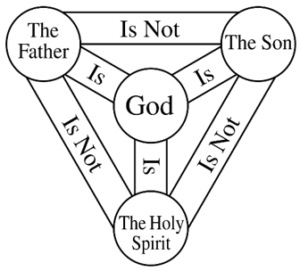 The terms “triune” and “Trinity” are not found anywhere in the Bible; however, the biblical description of God’s nature is, and the early Church Fathers drew upon these Scriptures to formulate the understanding of God as one spiritual being who exists eternally in three distinct persons.[6]
There is no possible way that we can begin to fathom and explain the fullness of God’s nature. But God has chosen to reveal enough of himself through his Word to allow us to develop a simplistic yet meaningful understanding of his nature. I find it intriguing that God uses anthropomorphic[7] language to describe himself and his nature. I believe he does this so that we might acquire some understanding of his divine nature as he reveals the Father’s relationship to the Son, relationships we can grasp through our own human experiences. Let’s look at some revelations of God’s triune nature to deepen our understanding of his essence.
One God – God affirmed to the Israelites and to us, “Hear, O Israel: The Lord our God, the Lord is one.” (Deuteronomy 6:4) And again, through the prophet Isaiah, God spoke, “I am the Lord, and there is no other; apart from me there is no God.” (Isaiah 45:5) These verses testify that there is only one true God, one being that exists. This is why Christians are monotheistic[8], believing and worshipping in only one God.
God the Father – There are a multitude of biblical verses in the Old and New Testaments that refer to God as our Heavenly Father. The apostle Paul wrote, “Yet for us there is but one God, the Father, from whom all things came and for whom we live…” (1 Corinthians 8:6), and the apostle John wrote, “For on him God the Father has placed his seal of approval.” (John 6:27b) These two verses and many more identify God as the Father.
God the Son – One of the most powerful sets of verses that identifies the Son, Jesus Christ, as God, is contained at the start of John’s gospel, “In the beginning was the Word, and the Word was with God, and the Word was God. He was with God in the beginning. Through him all things were made; without him nothing was made that has been made.” (John 1:1-3) Several verses later John proclaims, “The Word became flesh and made his dwelling among us. We have seen his glory, the glory of the one and only Son, who came from the Father, full of grace and truth.” (John 1:14) These verses together identify John’s teacher, Jesus, not only as the Son of the heavenly Father and not only as someone present with God at creation but also as God, who created all things! In another passage the apostle Paul refers to Jesus as absolutely immortal and divine when he writes, “For in Christ all the fullness of the Deity lives in bodily form…” (Colossians 2:9) Dr. James Orr (1844–1913) was a Scottish Reformed theologian who stated regarding the title of the Son of God, “This title is one to which there can be no finite comparison or analogy. The oneness with God which it designates is not such reflex influence of the divine thought and character such as man and angels may attain but identity of essence constituting him not God-like alone, but God.”[9] In other words, the Son’s oneness with the Father is a shared essence. The Son is what God is, the same substance. Orr is in alignment with Paul’s statement in Colossians 2:9; Christ is the fullness of the deity.
God the Holy Spirit – As Christians, we know the least about the person of the Holy Spirit as God. This may be the reason some people mistake the Holy Spirit for a force or power of God, rather than a person of God. It is true that the Holy Spirit has the power to change hearts, provide counseling, grant us wisdom, and emotionally and physically heal us, but the scriptures are also clear about the person of the Holy Spirit as a person of God. Jesus’ disciples understood this as revealed in their New Testament letters once Jesus ascended into heaven. In the Book of Acts, Luke records a discussion between Peter and Ananias, one of the disciples. “Then Peter said, “Ananias, how is it that Satan has so filled your heart that you have lied to the Holy Spirit and have kept for yourself some of the money you received for the land? Didn’t it belong to you before it was sold? And after it was sold, wasn’t the money at your disposal? What made you think of doing such a thing? You have not lied just to human beings but to God.” (Acts 5:3-4) In this passage, Peter refers to the Holy Spirit as a person, not a power or force of God. He also equates the Holy Spirit to God himself when he says, “You have not lied just to human beings but to God.”
Elsewhere in the New Testament, the apostle Paul admonished his readers in the church at Corinth, who should have been spiritually mature by now but still lived as infants in Christ. Paul continues, “Don’t you know that you yourselves are God’s temple and that God’s Spirit dwells in your midst? (1 Corinthians 3:16) Paul is admonishing these Christians that as believers, their bodies are God’s temple where the Holy Spirit dwells. Paul is referring to the Holy Spirit as God who resides in us.
Three Persons in God – Finally, the Bible provides several passages where all three persons of the triune God are mentioned. In these passages, the Father, Son, and Holy Spirit are presented together while remaining distinct from one another. In the apostle Matthew’s account of Jesus’ baptism, he records, “As soon as Jesus was baptized, he went up out of the water. At that moment heaven was opened, and he saw the Spirit of God descending like a dove and alighting on him. And a voice from heaven said, “This is my Son, whom I love; with him I am well pleased.” (Matthew 3:16-17). In this account, Matthew is intentional in recognizing and distinguishing the three persons of God as being present in this event. In another of Matthew’s passages, Jesus gave final instructions to his disciples as he commanded them to, “Therefore go and make disciples of all nations, baptizing them in the name of the Father and of the Son and of the Holy Spirit.” (Matthew 28:19) In this verse Jesus commands his disciples to use the singular noun “name” to identify one God with three distinct persons.
In summary, God’s nature is complex and beyond our reach to fully comprehend or explain. But fortunately, God has revealed a portion of his nature to us through his Word, which allows us to appreciate and adore his majesty and greatness and to give evidence that the God of the Bible is the one and only God! Now what about God’s character? What type of personality does God possess? In what ways does his makeup match our own? In the second article titled “What is God Like?—God’s Character,” we will explore some of God’s major attributes that make up his character.
NOTE: Unless otherwise indicated, Scripture quotations in this series of articles are from the HOLY BIBLE, NEW INTERNATIONAL VERSION. Copyright © 1973, 1978, 1984, and 2011 by International Bible Society. In all articles, statements from Jesus as recorded in the Gospels will appear in bold, italicized quotation marks, while all other Scripture passages will be presented in italicized quotation marks.
For the complete set of What is God Like? articles, visit my website library at Seekandfindgod.org
Endnotes
[1] Psalm 147:4 “He determines the number of the stars and calls them each by name.”
[2] William Evans, The Great Doctrines of the Bible, Moody Publishers, 1912, Pages 18-36.
[3] Wayne A. Grudem, Systematic Theology, an introduction to biblical doctrine, Zondervan Publishing House, (Grand Rapids, Michigan,1994) Pgs. 187-188.
[4] Big Bang’s Initial Singularity – Explained by some astrophysicists as the beginning of our physical universe caused by an infinitely large explosion of energy that expanded the physical elements in the universe.
[5] Wayne A. Grudem, Systematic Theology, an introduction to biblical doctrine, Zondervan Publishing House, (Grand Rapids, Michigan,1994) Pg. 226.
[6] The Nicene Creed and the Apostle’s Creed are great examples of the early church father’s statements of belief about the triune nature of God.
[7] Anthropomorphic – attributing human characteristics, qualities, emotions, actions, or physical features to something that is not human.
[8] Monotheistic – believing in, or relating to belief in, the existence of only one God.
[9] William Evans, The Great Doctrines of The Bible, Moody Publishers, 1912, Pg. 59.