
As far back as I can remember, I’ve always had a deep interest in science and especially astronomy. Anyone who really knows me is not surprised by that. I occasionally ponder over the following passage in Psalms about the cosmos that says, “The heavens declare the glory of God; the skies proclaim the work of his hands. Day after day they pour forth speech; night after night they reveal knowledge. They have no speech, they use no words; no sound is heard from them. Yet their voice goes out into all the earth, their words to the ends of the world. In the heavens God has pitched a tent for the sun.” (Psalm 19:1-4) The splendor of the night sky shouts God’s glory and power, his creation, and his creativity. But they provide us with much more than just his glorious handiwork. For the cosmos speaks to us as it reveals God’s knowledge. In much the same way that a classical artist expresses his thoughts, feelings, and identity through his masterpiece on canvas, God reveals His nature and essence through the creation displayed in the skies above us! This is identical to his revelation through his words in scripture.
In our last article, we ventured into the predictive prophecies of the Bible and reviewed some convincing evidence in support of the Bible’s prophetic reliability. But how does the Bible stand up against the physical wonders of our universe? Specifically, I’m talking about the modern-day conflicts between the Bible vs. science. Would God create a cosmos to reveal himself that would contradict the revelations he inspired in his Word, the Bible? If we did find conflicts between science and the Bible, we would be forced to question the accuracy of one or both of these disciplines, or maybe even God himself.
These last two articles will address these weighty issues and, to borrow a familiar idiom, let the chips fall where they may! Due to the enormous amount of scientific evidence to cover, this material will be divided into two articles.
Scientific Challenges to the Bible
Several scientific disciplines—including physics, geology, astronomy, biology, and paleontology (the scientific study of prehistoric life through the analysis of fossils)—are often cited as presenting challenges to the Bible’s scientific reliability in our modern era.[1] I will address these challenges in two parts. First, I will discuss the precautions we must follow when interpreting scientific and biblical data. In the next article, we will examine several significant and widely debated areas of contention to determine whether these two disciplines can exist in harmony.
What key scientific precautions should students of the Bible, scientists, and everyday readers be careful to observe?
Scientific Precautions
Let’s start by exploring the basic definition of the word “science.” The Oxford English Dictionary defines science as “the systematic study of the structure and behaviour of the physical and natural world through observation and experiment.”[2] Therefore, scientists rely on empirical evidence that is observed and measured. Scientists also employ models and theories that develop and mature over time to refine their hypothesis as more data is examined.
Physical Reality
For the purposes of this discussion, I’ll use the phrase “physical reality” to mean what actually exists in the material universe: matter, energy, space, time, and the observable consequences of those things. Therefore, a systematic scientific study (science) that captures and reports on the physical reality of a natural event or behavior is factual and truthful.
Given our definition of science, we can objectively agree that the systematic study of science does not always represent reality. Hear me out on this… I say this because the reliability of cutting-edge scientific hypotheses depends on the quality and quantity of the data collected and the precision with which scientists conduct their observations and experiments to develop sound theories. Initially, experimental results may be incomplete or imprecise, but over time, through repeated observation, continued experimentation, and improved data, scientists develop increasingly accurate models that better reflect the physical realities being studied. That’s the way scientific research works. Science cannot describe behaviors outside of space and time.
It’s also important to note that science isn’t able to describe behaviors or establish theories outside our natural universe or metaphysical realm. The rationale behind this statement is that scientists are incapable of making observations or experimenting with events outside of our physical universe. Therefore, the discipline of science should not be used to develop assumptions and hypotheses about the metaphysical realm.
What key biblical precautions do scholars of the Bible, scientists, and everyday readers be careful to observe?
Biblical Precautions
When reading scriptures that intersect with the behaviors of nature, we are obliged to exercise careful judgment in their interpretation. We should keep in mind that God never intended his inspired Word to be a scientific textbook nor intended it to provide us with a detailed account of our world’s physical functioning.
In addition, biblical readers should be careful not to quickly react by reinterpreting the Bible in response to every new scientific theory addressing our physical or biological world. When we do so, we weaken the reliability of the Bible, and it becomes entrapped in the changing path of scientific thought.
Biblical Reality
As we continue with this discussion, I would like to use another term I’ll identify as “Biblical Reality” and define it as what is truthfully revealed in the Bible according to God’s revelation. Biblical reality is an event that has or will occur as revealed by scripture or a true principle or command revealed by God directly or through his people.
Let me explain this term more clearly by example. The Book of Revelation scholars interpret identical Scripture passages differently to support their pre-tribulation, mid-tribulation, or post-tribulation (or other) eschatological positions. These are all probable end-time scenarios, but only one of these events will actually occur as determined by God. This one event is biblical reality.
Don’t miss this important point: while the Bible is not intended to reveal nature’s formulas of mathematics or other complex scientific principles, the biblical reality of the Bible should never contradict the physical reality of nature. That is because the same God that inspired the words we find in the Bible also created our physical universe with its physical and natural laws; therefore, the two must be congruent where an overlap exists between these disciplines.
Another critical precaution biblical students should apply while interpreting the Bible is proper exegesis.[3] Exegesis is a careful, systematic interpretation of a biblical text to understand its original meaning in its historical, literary, and theological context.
Throughout history mankind has sought to discover and understand the physical and biblical realities of our world and God. Some of the time these two arenas have converged in support of one another, while at other times biblical scholars and scientists have completely disagreed with one another over their defended positions. In the second part of this article, I would like to provide a few historical examples where both the Church and science have failed in seeking the truth in their related fields of study. My hope is that these stories will offer lessons that meaningfully guide and enrich our pursuit of truth.
The first example is about Claudius Ptolemy, a Greco-Roman polymath[4] who was born about 6 years after Christ died on the cross. Ptolemy wrote The Great Treatise, in which he used 800 years of celestial observations by previous astronomers to prove that the earth was the center of the observable universe. His work was published around AD 160. Ptolemy’s universe was accepted as settled science for about 1,500 years. Thomas S. Kuhn, who wrote The Copernican Revolution, explained that the Catholic Church adopted Ptolemy’s model as official doctrine and began using it as proof of certain elements of theology and the model of God’s creation, proving the Genesis account.[5] Having relied so heavily on this scientific theory, the Catholic Church even identified various scriptures to support this theory.[6] Therefore, the Catholic Church was not ready to back away from their position when Copernicus published his manuscript, On the Revolutions of the Heavenly Spheres, in 1543, proving that the sun was the center of the solar system, not the earth.[7]
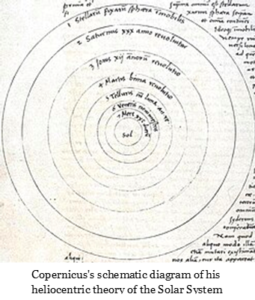
To avoid being accused of heresy by the Church, Copernicus delayed publishing his manuscript until he was near death. Almost 70 years later, in 1610, during the time most astronomers still supported the Ptolemaic theory, Galileo began to speak publicly in support of the Copernican theory based on Galileo’s observations through his much-improved telescope. He was denounced to the Inquisition. When he published his Dialogue Concerning the Two Chief World Systems[8] in 1632, the Inquisition tried him and found him guilty of “vehement suspect of heresy,” and he was forced to recant and was placed under house arrest until his death in 1664, almost 30 years later.
This story illustrates the dangers of the Church in using the Bible to support the contemporary scientific thoughts of the day without a careful and disciplined interpretation of a text to understand what the biblical author intended to communicate in its historical, literary, and cultural context. We should view this example as a reminder that science should not be used as a starting point to harmonize the two disciplines whenever science uncovers a physical theory that may intersect with the text in the Bible.
The Origin of the Universe
Let’s take a look at another historical account of one of the most hotly debated scientific issues of our time: the origin of the universe. Many past philosophers and scientists, including Aristotle and Newton, assumed an eternal, unchanging universe. This idea was generally carried forward because there was no observational evidence to suggest otherwise. But let’s first take a quick look at what the Bible has to say about the origin of the universe.
We find in the first verse of the first chapter of the Bible: “In the beginning God created the heavens and the earth.” (Genesis 1:1) We can learn from this that the universe has a definite beginning, and God was the initiator of it. In the New Testament, the apostle John wrote, “Through him all things were made; without him nothing was made that has been made.” (John 1:3) This verse supports the notion that God created everything in our universe. Back in the Old Testament we can find: “By the word of the Lord the heavens were made, their starry host by the breath of his mouth.” (Psalm 33:6) In these verses, it is clear that the authors viewed God as the creator of the heavens, and therefore the universe didn’t always exist. In addition to these verses, the Bible contains many other passages that affirm God as the sole source and creator of the universe.
Now let’s turn our attention back to the scientific account in question. In 1915, Albert Einstein developed his General Theory of Relativity, which suggested the universe was not static. Einstein could not believe the results of his research and consequently modified his equations by inserting a cosmological constant in his equations to fit the static universe model.[9] Einstein would later admit this was the biggest mistake of his life. Years later, in 1929, Edwin Hubble, who was a research astronomer, measured the relationship between the redshift and distance of other galaxies and concluded that the farther galaxies were actually receding away faster than the closer galaxies. This meant that we lived in an expanding universe![10] But more significant was the fact that our universe was no longer considered static and eternal but that it had a beginning: a singularity of infinite temperature, density, and pressure. An instantaneous spark that came from nothing created the universe that exists today. This cosmic event has been identified as the Big Bang.
 It truly is ironic how the tables have turned! I find it interesting that whereas the religious community had found it challenging to argue the existence of God in a static universe, now the scientific community was challenged to defend how the universe flashed into existence without a God.
Robert Jastrow was a professed agnostic and was director of the Mount Wilson Observatory and founder of NASA’s Goddard Institute of Space Studies. Given his religious position, his theistic quotations are all the more startling. Regarding the overwhelming evidence pointing to the creation of our universe, Jastrow writes, “Now we see how the astronomical evidence leads to a biblical view of the origin of the world. The details differ, but the essential elements in the astronomical and biblical accounts of Genesis are the same: the chain of events leading to man commenced suddenly and sharply at a definite moment in time, in a flash of light and energy.”[11]
Interestingly, before modern astronomy and cosmology had advanced, an 11th-century Persian philosopher developed a logical argument for the creation of the universe and the existence of God. I would like to share this short but powerful argument with you.
The Kalam Cosmological Argument
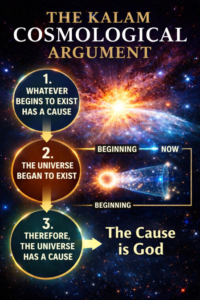
Dr. William Lane Craig, in his book, The Kalam Cosmological Argument, states that this philosophical argument is named after the Kalam (medieval Islamic scholasticism) and the Persian Muslim philosopher, Al-Ghazali, from whom many of his key ideas originated.[12] In its most basic form, the Kalam Cosmological Argument is a philosophical and theological case for God as the cause of the universe and worthy of mention. This cosmological argument rests on three basic rules:
- Whatever begins to exist has a cause. Grass, buildings, and people all came to be because something caused them. This rule is consistent with our modern scientific principle of cause and effect.
- The universe began to exist. Based on modern science, the universe expanded from a singularity explosion. The universe is winding down and therefore cannot be eternal, based on the second law of thermodynamics.
- Therefore, the universe has a cause. Someone from outside our universe caused the universe to begin. Someone of immense power chose to create our universe. This outside powerful cause is God.
 This is a remarkable and purely logical defense for the existence of God and the creation of our universe. Over the course of the last hundred-plus years, mankind has made great advances in astronomy and cosmology to help answer the question about the origin of the universe from a scientific perspective.
But prior to this time, the scientific community alleged that our universe was static and eternal, and some scientists argued that these scientific theories presented a clear argument that God did not exist.
The British physicist Stephen Hawking was one of the most prominent scientists in contemporary times to hold this view. He once stated, “There is no God… I am an atheist,” and “science offers a more convincing explanation for why the world exists.”[13]
So where does this discussion leave us?
As you can see, the debate between the Bible and science is extremely complex and challenging. On the one hand, the scientific community, in its search to understand the physical reality that explains our universe’s wonders and behaviors, has established hypotheses and theories to support its work. But as has been seen in the past, scientists have sometimes used science to advance hypotheses about the metaphysical realm without any ability to measure, test, or verify their claims. There have also been times in history when scientific theories, built on incomplete data and limited testing, were used to promote conclusions that did not reflect physical reality and stood in contradiction to the biblical position. The steady-state universe theory is one example.
On the other hand, we had an early church community that was deeply committed to seeking the biblical reality in the Bible, for it possessed the spiritual truth and hope for its people. But in the past this community has sometimes attempted to use Scriptures as a means to explain the behaviors of nature.
As I mentioned before, God never intended the Bible to be used as a scientific tool. With its sixty-six books, multiple literary genres, diverse geographic settings, and numerous human authors, the Bible requires a systematic approach if readers are to understand its original meaning within its historical, literary, and theological contexts.
In the next and final article of this series, we will continue to explore the challenges facing both the Bible and science, as well as examine areas of convergence and controversy. It is my hope that this final article will give us the evidence we need to better judge the Bible as a reliable pathway to God.
ENDNOTES
[1] Portions of this section are adapted from my previously published small group series by Robert A. Mimiaga and Lew Davies, “Can You Really Trust the Bible?” (New Hope Church, Bend, OR, 2011)
[2] Oxford English Dictionary Online, s.v. “science, accessed November 2025)
[3] Exegesis is the critical explanation or interpretation of a text, especially a religious scripture, to uncover its original meaning by analyzing its historical and literary context, rather than reading one’s own ideas into it
[4] An individual who excels in multiple fields of study or practice is a polymath. Traditionally, we consider someone a polymath if they have an encyclopedic memory, or personality traits that drive them to interconnect multiple areas of interest.
[5] Kuhn, Thomas S. The Copernican Revolution: Planetary Astronomy in the Development of Western Thought, Harvard University Press, 1957.
[6] Psalm 93:1 “The world is established; it shall never be moved.”
Psalm 96:10 “…the world is established, it shall never be moved.”
Psalm 104:5 “He set the earth on its foundations, so that it should never be moved.”
1 Chronicles 16:30 “…the world is firmly established; it cannot be moved.”
Joshua 10:12–13 “Sun, stand still at Gibeon…” and “…and the sun stopped…”
[7] Copernicus, Nicolaus. De revolutionibus orbium coelestium (On the Revolutions of the Heavenly Spheres). Norimbergae: Johannes Petreius, 1543. — First edition, published in Nuremberg in the year of Copernicus’s death.
[8] Galilei, Galileo. Dialogue Concerning the Two Chief World Systems: Ptolemaic and Copernican. Translated by Stillman Drake. Berkeley: University of California Press, 1953.
[9] Rugh, S; Zinkernagel, H. (2001). “The Quantum Vacuum and the Cosmological Constant Problem”. Studies in History and Philosophy of Modern Physics. 33 (4): 663–705.
[10] Hubble, Edwin. “A Relation between Distance and Radial Velocity among Extra‑Galactic Nebulae.” Proceedings of the National Academy of Sciences 15, no. 3 (1929): 168–173.
[11] Robert Jastrow, God and the Astronomers, 14. Grand Central Pub, 1980.
[12] William Lane Craig, The Kalām Cosmological Argument (Eugene, OR: Wipf & Stock, 1979)
[13] Clark, Heather. “Physicist Stephen Hawking Claims ‘There Is No God,’ Says He Is Atheist.” Christian News Network, September 26, 2014.