

I’m glad you’ve chosen to continue to walk this journey with me as we seek a deeper understanding of how truth shapes our lives. In the previous article, we explored various secular definitions of truth and were left with a growing sense of uncertainty about how our culture interprets its meaning. In this article we will hear from a variety of early church and modern-day theologians speaking about objective and subjective truth and their consequences on our culture. We will also turn to Scripture to see what divine revelation can be learned about truth.
It might not surprise you that a recent Barna Group poll showed that a large portion of Americans view truth as something felt or relative to a situation. The results of the poll stated that truth is increasingly regarded as something felt, or relative (44%), rather than something known, or absolute (35%).”[1] In our last article we discussed some of the reasons for this shift, resulting from the influence of Western philosophers and academia professors in our society. In addition, a majority of today’s younger generation accepts the idea that truth and morality are not fixed but change with society or personal perspective.[2]
Early Church’s Understanding of Truth
There exists a large collection of writings from early church leaders about their views on truth from a Christian perspective. One individual is Augustine of Hippo (AD 354–430), who was a Christian theologian and philosopher from Roman Africa and bishop of Hippo, which is in modern-day Algeria. Regarding the absoluteness of truth, Augustine wrote, “Truth is not changed by time, nor is it altered by place, nor is it subject to accident.”[3] In this statement, Augustine explicitly rejects relativism and reasons that truth does not evolve with culture or circumstance but remains constant regardless of the cultural or situational context it is embedded into.
 Another early church leader, Irenaeus of Lyons (AD 130–202), who was a Greek bishop and defender of the faith, professed about the objectivity of truth and warned about deception that is so cleverly appealing that it can appear to be truthful to the untrained eye. Irenaeus stated, “Error, indeed, is never set forth in its naked deformity, lest, being thus exposed, it should at once be detected. But it is craftily decked out in an attractive dress so as, by its outward form, to make it appear to the inexperienced more true than the truth itself.”[4]
It is interesting to note that subjective truth and its deception were a challenge to society and the church dogma as early as the second century. There are dozens of early church fathers who voiced a similar view regarding the objectivity of truth.
The Modern Church’s View of Truth
We can easily find a large number of contemporary Christian theologians that have written volumes about our culture’s current distortion of objective truth and the challenges our church faces in philosophy. One of my favorites is R. C. Sproul (1939–2017), who was an American Reformed theologian, Christian apologist, and Presbyterian pastor. He was also the founder of Ligonier Ministries, which is still entirely committed to providing sound biblical theology through podcasts and Sproul’s many published books. When challenged about the importance of absolute truth in the church, Sproul responded, “If there is no absolute truth, then there is absolutely no truth.”[5] This simple but powerful statement encapsulates Sproul’s argument that relativism is self-defeating, because denying absolute truth requires making an absolute claim. A simple example of this argument might be given by someone who says, “There are no rules.” This statement claims to be an absolute rule while claiming that no rules exist.
Timothy James Keller (1950-2023) was an American Presbyterian pastor, Reformed theologian, and Christian apologist. Keller was in total agreement with Sproul’s comments about relative truth, as he stated, “To say ‘all truth is relative’ is itself a universal truth claim. If truth were truly relative, that statement could not be true for everyone. The very act of denying absolute truth assumes that some truth is, in fact, absolute.”[6]
Another Christian scholar is John McElphatrick Frame, who is a retired American Christian philosopher and Calvinist theologian. In his book titled The Doctrine of the Knowledge of God, Frame states that “Truth is what God says, and it is therefore personal as well as propositional. God himself is the standard of truth, and his Word expresses that truth to us. To know truth rightly, we must know it in relation to him.”[7] Did you catch what Frame just said? God is the yardstick by which we should come to know truth, and absolute truth is found in his Word, the Bible. Therefore, if we aspire to know truth—that is, to understand reality—we must seek it in the Scriptures, which teach us how to view God, how to treat others, and how to live righteously in this world.
What the Bible Says About Truth
Looking at the New Testament of the Bible, the Greek term for “truth” is “alētheia,” meaning that which is in accord with what really happens, facts that correspond to a reality, whether historical.[8] In this context, the Bible’s statements about truth align closely with the Christian theologians we just read above, which affirms that truth is that which corresponds to reality—whether physical or spiritual. Let me provide a small list of verses from the Bible that proclaim the endless qualities of God’s truth.
God’s truth is immutable: “All your words are true; all your righteous laws are eternal.” (Ps 119:160) This passage emphasizes God’s laws being truthful and immutable.
God’s truth is transformative: “Sanctify them by the truth; your word is truth.” (John 17:17) Jesus, who is praying to the Father, is asking Him to make his disciples holy as they live in objective truth, the truth that comes from God, the truth that is in His Word.
God’s truth is Everlasting: “The grass withers and the flowers fall, but the word of our God endures forever.” (Isaiah 40:8) In this verse the prophet Isaiah proclaims the eternal qualities of God’s truth in His Word.
God’s truth is Trustworthy: “The works of his hands are faithful and just; all his precepts are trustworthy.” (Psalm 111:7) God’s works of truth in the Bible are to be completely reliable.
 God’s truth is Complete: “I know that everything God does will endure forever; nothing can be added to it and nothing taken from it. God does it so that people will fear him.” (Ecclesiastes 3:14) God’s truth is not lacking but complete. True in all times, true in all places, true for all people.
These passages, together with many others, support the position that the truth set forth in Scripture is inherently absolute, extending beyond theology to every practical relationship and situation we encounter with God and others.
How Do These Truths Affect Our Culture?
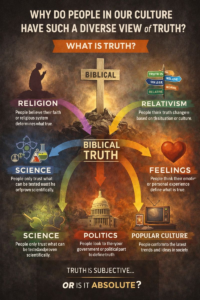
As I’ve mentioned before, we live in a culture that views truth two different ways, as subjective truth and objective truth. Let’s take a deeper look at these two worldviews to see how they affect our culture.
Subjective truth (similar to relative truth) is defined as truth that is influenced or determined by an individual’s personal feelings, experiences, or opinions. The key emphasis is on a person having the freedom to decide what is true. We can also append to this truth relative truth, which is created and fashioned by a group, culture, or situation. Some examples of subjective truth in our culture can be heard in expressions like “I need to live my truth,” or “What is right for me may not be right for you,” or “That might be true in your group, but not in mine.” From a personal perspective, people might feel justified in lying or stealing if it benefits them or their community. Alternately, some people might rationally believe that it’s ok to do something immoral if it doesn’t hurt anyone else. Through the lens of subjective truth, a belief might be considered acceptable under certain social or cultural conditions, depending on how a culture interprets what is true. In a spiritual context, individuals or groups applying subjective truth in their faith may surmise that “It may be a sin for you, but God has allowed it for me” or “It’s ok for you to believe in hell; I just don’t believe in it.”
Objective truth (also referred to as absolute truth), on the other hand, is truth that exists independent of any person’s or society’s opinions, emotions, or perceptions. A couple of simple examples of objective truth in our world are “Where light is present, darkness cannot remain” or the equation “1+1 is always two.” These facts are always correct regardless of what any person rationalizes.
In the Christian’s spiritual realm, objective truth is associated with God’s divine revelation, not human reasoning or experiences. Since God is infinite, immutable, and eternal, his truth never changes and always exists. Examples of this reality include God’s commands such as “to demonstrate love toward others is always good” and “killing is always morally wrong.” These are moral absolutes established by God, independent of any justification that might be offered through human rationalization.
Norman Leo Geisler, who was an American Christian theologian, philosopher, and apologist, said the following about objective truth: “Truth is not relative. It is an unshakable reality completely immunized from all subjectivity. All truth comes from God and is the immovable tower standing above the shifting sands of human reason.”[9]
In the secular community, when everyone starts to create their own “truth,” society loses a common ground for discussion, making meaningful dialogue difficult. People design their own version of truth, leading to a proliferation of conflicting viewpoints and worldviews, impacting fruitful dialogue among members of our society. We can see this influencing our social justice, government legislation, politics, and even the social media community.
When our culture accepts truth as subjective, it communicates information that is shaped at will, making false claims easier to spread. When truth becomes subjective, the lines between fact and fiction blur, making it challenging to make informed decisions.[10] When truth is viewed subjectively, moral rules can lose their importance and are often replaced with principles to live by that are based on our desires and preferences instead of biblical truth. What is determined to be right or wrong becomes unclear and distorted. Unfortunately, we are seeing a sharp rise in social division and polarization as society drifts from a shared understanding of truth toward a subjective worldview that distorts reality and fragments perspectives across our society.
Another example of the negative effects of subjective truth in our culture is the distrust of experts, business executives, government politicians, and institutions. This results in a decline in trust of our law enforcement, military, legal systems, government leaders, and educational institutions. Our world is increasingly fragmented, divided between those who believe in objective reality and those who claim truth is relative.[11]
 We can clearly see the serious impact subjective truth is having on our society. As Christians we need to be constantly aware of its influences in our culture and stand up against the spiritual threats that confront us. Keep in mind what the apostle Paul wrote in his letter to the Corinthians that is just as relevant to us today: “We demolish arguments and every pretension that sets itself up against the knowledge of God” (2 Corinthians 10:5a) Stand firm in protecting your faith.
As we continue our journey in understanding the meaning of truth, our next article will explore what Jesus taught about truth and take a closer look at what He said about Himself in relation to this reality. What you learn next will change your perception about the implications of truth.
ENDNOTES
[1] The Barna Group. “The Trends Shaping a Post-Truth Society,” Barna.com, 2018.
[2] Barna Group and Impact 360 Institute, “Gen Z: The Culture, Beliefs and Motivations Shaping the Next Generation” (Ventura, CA: Barna Group, 2018), https://www.impact360institute.org/articles/a-majority-of-gen-z-wants-to-create-their-own-truth/
[3] Justin Martyr, Second Apology 10.
[4] Irenaeus, Against Heresies 1.2.1, trans. Alexander Roberts and William Rambaut, Ante-Nicene Fathers, vol. 1 (Peabody, MA: Hendrickson, 1994).
[5] R. C. Sproul, Essential Truths of the Christian Faith (Wheaton, IL: Tyndale House, 1992)
[6] Timothy Keller, The Reason for God (New York: Dutton, 2008).
[7] John M. Frame, The Doctrine of the Knowledge of God (Phillipsburg, NJ: P&R Publishing, 1987).
[8] Swanson, J. (1997). In Dictionary of Biblical Languages with Semantic Domains: Greek (New Testament) (electronic ed.). Logos Research Systems, Inc
[9] Norman L. Geisler, quoted in “Truth is not relative,” BibleApologetics.org
[10] All Research Journal, vol. 7, no. 3 (2021): “The Impact of Post‑Truth on Society.” (allresearchjournal.com)
[11] Felix Songolo, “The War on Truth: Why Objective Truth and Not Moral Relativism Builds a Strong Society,” Medium. (medium.com)