
Let me invite you to pause for a moment and consider a simple question: how would you define truth? What is truth to you? This series will give you an opportunity to compare your thoughts about truth with philosophers and scholars in the past and present. Welcome to this fascinating journey to discover what is truth!
Speaking of journeys, if you’ve ever been hiking in an unknown area but brought along a compass and a trail map, you step forward with confidence, trusting that this simple instrument will guide you along the right path. This confidence comes from knowing your compass is truthful in pointing its needle toward magnetic north to provide you with a reliable reference for direction—or perhaps you just trust its magical powers. But what about important decisions and life directions that we can’t easily find a solution for? How and where do we look for a truthful answer?
As we reflect on our culture today, our society struggles to find truth using human reasoning in every aspect of our lives. Have you ever wondered who has the right to define what truth is? Should truth be defined democratically by a majority of people who agree with a given law, perception, or opinion? Should each person possess the freedom to determine what is true, apart from all external authority? Or should truth be founded by something more substantial than opinions, perceptions, and preferences?
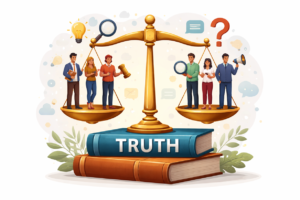 This brings me to the purpose for this article series titled “What is Truth?” This three-article series will examine the origin of our modern culture’s understanding of truth and compare it with the Bible’s and Jesus’ view of truth to determine how these perspectives shape the world we live in. We will also wrestle with the reasons why people view truth so differently in our modern culture. Finally, as we review the data, we will establish a sound conclusion about what truth is, based on the evidence we have discovered. But let’s first take a few steps back to gain an agreed-upon understanding of what we mean by the term “truth.”
Truth Defined in Our World
So how is truth defined? The Cambridge Dictionary defines truth as “the real facts about a situation, event, or person.”[1] The Merriam-Webster Dictionary defines truth as “the body of real things, events, and facts.”[2] Finally, in searching for a meatier definition of the term, Encyclopedia Britannica defines truth as “truth in metaphysics and the philosophy of language, the property of sentences, assertions, beliefs, thoughts, or propositions that are said, in ordinary discourse, to agree with the facts or to state what is the case.”[3]
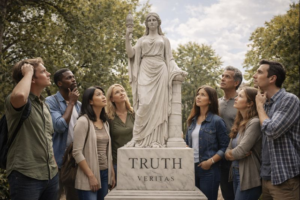 All these definitions vary in description and detail but have a common theme. They all agree that truth is based on a fact or some reality that is completely accurate. Unfortunately, in recent decades our culture’s standard for truth has decayed. We now find ourselves becoming increasingly skeptical about what we hear from our news programs, our online news websites, and our social media platforms. A recent Pew Research Center survey found that a large majority of U.S. adults see disagreement over basic facts as a major problem. Many respondents reported difficulty distinguishing truth from falsehood when it comes to statements by elected officials and information encountered on social media and cable news.[4]
Much of this misinformation stems from malicious and manipulative intent, and the volume of such information we encounter continues to grow over time. In this day, it is easy to create false narratives on social media platforms under the protection of anonymity. I believe the primary reason for disunity in our worldviews is humanity’s fallen nature resulting from sin.
Western Civilization’s Definition of Truth
When we look at the big picture, historically speaking, we can begin to understand the philosophical influences over the ages that have caused social and cultural changes in our Western culture. From a secular standpoint, the interpretation of truth has shifted from objective discovery through reason and science to skepticism, relativism, and personalized narratives. From the classical philosophies through the Enlightenment period, the interpretation of truth has become distorted and molded into a reality designed by man.
Let’s take a quick look at Table 1 below that shows us a fascinating chronological picture of the progression of the view of truth through the ages. Pay close attention to the rightmost column and notice key changes in the interpretation of truth as influenced by the philosophies of the day. From this table we can quickly see a rapid progression in the perception of truth in the last two hundred years. There is no doubt that these changes in philosophical views of truth have influenced the understanding of truth in our present times.
Table 1: Chronological Study of Western Civilization’s Definition of Truth
Historical Period | Approx. Dates | Dominant View of Truth | Key Change in the View of Truth |
Pre-Socratic Philosophy | c. 600–400 BC | Truth is discovered through rational inquiry into nature rather than myth.[5] | Shift from mythological explanations to reason-based investigation of reality. |
Classical Greek Philosophy | c. 400–300 BC | Truth is objective and corresponds to reality (Platonic forms; Aristotelian correspondence).[6] | Truth becomes systematically defined through logic and metaphysics. |
Hellenistic & Roman Thought | c. 300 BC–300 AD | Truth is connected to practical wisdom, ethics, and lived experience.[7] | Emphasis moves from abstract metaphysics to pragmatic and skeptical approaches. |
Medieval Scholasticism (Secular Methods) | c. 500–1500 | Truth is objective, ordered, and knowable through rational analysis.[8] | Truth is preserved and systematized through formal logic. |
Scientific Revolution | 16th–17th c. | Truth is empirically verifiable and mathematically describable.[9] | Authority and tradition are replaced by experimentation and observing. |
Enlightenment | 17th–18th c. | Truth is rational, universal, and accessible through human reason.[10] | Human reason becomes the primary authority for truth. |
19th-Century Critiques | 1800s | Truth is shaped by power, economics, and human cognition.[11] | Confidence in neutral, objective truth begins to erode. |
Logical Positivism & Modernism | Early to mid-20th c. | Truth must be empirically verifiable or logically provable.[12] | Truth is narrowed; metaphysical claims are dismissed. |
Postmodernism | Mid–Late 20th c. | Truth is socially constructed and power-laden.[13] | Universal and objective truth claims are actively deconstructed. |
Digital / Post-Truth Era | 21st c. | Truth is fragmented, personalized, and narrative-driven.[14] | Shared standards of truth lead to emotional and identity-based belief. |
 How Our Modern Culture Views Truth
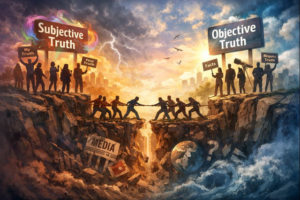
As a result of these philosophical changes throughout history, not only has our society’s thinking been affected, but so has its behavior. We can categorize our society’s perception of truth into two major distinct groupings. Scholars and philosophers generally group these perceptions of truth in a variety of ways (with a multitude of variations), but I have adopted the following two basic groupings as a framework for our discussions.
Objective Truth (Absolute Truth) is based on what is true, independent of human opinion, perception, or belief. It does not change, evolve, or depend on human perception. “Absolute truth” is similar and means “complete and total,” and something that is true or exists without exception, limitation, or condition.
Subjective Truth (Relative Truth) is based on personal perspective, feelings, or experiences. What is true for one person may not necessarily be true for another. A closely associated worldview is called relative truth, which is based on cultural, societal, or situational contexts. What is considered true in one culture or era may not be viewed the same way in another.
We will examine these two categories of perception in greater detail in the next article. For now, consider a society like our own, where each individual holds to one of these views of truth—or perhaps a mixture of them—and seeks to impose those views on others. Furthermore, consider how these perceptions of truth are woven into nearly every aspect of our shared life: government, politics, education, sports, the arts, and even religion—touching almost every corner of society. Under such conditions, it becomes easier to understand why our society is so fragmented and why its unity as a nation under one government appears increasingly unstable. In our secular society, this decline results from slipping away from the worldview of absolute truth.
Frances Schaeffer, who was an American evangelical theologian and philosopher, stated, “If there is no absolute by which to judge society, then society is absolute. This is what we increasingly see today. People operate on the basis of what is expedient and not on what is true.”[15] Schaeffer’s point was that relativism is responsible for the cultural shift and moral instability we find ourselves in today. When truth disappears, society becomes its own authority.
Where Do We Go from Here?
It quickly becomes evident that human reasoning to interpret truth varies widely among philosophers, scholars, and the general public. Over the past century, philosophers have significantly influenced our Western culture to question objective truth, often advancing the idea that truth is relative rather than absolute. Throughout the last century, the influence of numerous postmodern philosophers has produced a multitude of alternatives to objective truth that have surfaced in our universities and intellectual think tanks.
In our next article titled Biblical Truth – Divine Revelation, we will take a deeper look at what the Bible teaches on this subject and hear from several contemporary Christian scholars on objective and subjective truth along with the implications of each worldview. You won’t want to miss what modern biblical scholars affirm about the truth of the Bible, as we consider the Christian perspective on the subject.
ENDNOTES
[1] “Truth,” Cambridge Dictionary, accessed January 26, 2026, https://dictionary.cambridge.org/dictionary/english/truth
[2] “Truth,” Merriam-Webster.com Dictionary, Merriam-Webster, accessed January 26, 2026, https://www.merriam-webster.com/dictionary/truth
[3] Simon W. Blackburn, “Truth,” Encyclopædia Britannica, accessed January 26, 2026, https://www.britannica.com/topic/truth-philosophy-and-logic
[4] Pew Research Center. Americans’ Struggles with Truth, Accuracy, and Accountability. Washington, DC: Pew Research Center, July 22, 2019.
[5] Kirk, G. S., J. E. Raven, and M. Schofield. The Presocratic Philosophers. 2nd ed. Cambridge: Cambridge University Press, 1983.
[6] Aristotle. Metaphysics. Translated by W. D. Ross. In The Complete Works of Aristotle, vol. 2. Princeton: Princeton University Press, 1984.
[7] Long, A. A., and D. N. Sedley. The Hellenistic Philosophers. Cambridge: Cambridge University Press, 1987.
[8] Grant, Edward. God and Reason in the Middle Ages. Cambridge: Cambridge University Press, 2001.
[9] Shapin, Steven. The Scientific Revolution. Chicago: University of Chicago Press, 1996.
[10] Kant, Immanuel. Critique of Pure Reason. Translated by Paul Guyer and Allen Wood. Cambridge: Cambridge University Press, 1998.
[11] Nietzsche, Friedrich. On the Genealogy of Morals. Translated by Walter Kaufmann. New York: Vintage Books, 1989.
[12] Ayer, A. J. Language, Truth, and Logic. New York: Dover Publications, 1952.
[13] Foucault, Michel. Power/Knowledge: Selected Interviews and Other Writings, 1972–1977. New York: Pantheon Books, 1980.
[14] McIntyre, Lee. Post-Truth. Cambridge, MA: MIT Press, 2018.
[15] Francis A. Schaeffer, How Should We Then Live? (Old Tappan, NJ: Revell, 1976).