

Welcome back to the second and final article of What is Moral Relativism? In our last article, we reviewed some examples of moral relativism played out in our culture; we also gained some understanding of when this theory originated and discussed the destructive influence it has on today’s culture. To ensure we are on the same page, let me begin by reviewing some key definitions related to this topic:
Morals are personal or societal rules that establish what is right and wrong.
Morality is a framework or system that helps someone determine right from wrong.
Moral Relativism is the belief that morals are not absolute or objective but may change with a person’s or culture’s beliefs and circumstances.
As discussed in the prior article, when we examine our society’s ideas and practices, we see the influence moral relativism plays out in people’s statements, habits, and actions. Unfortunately, there are times when the influence of moral relativism is so deceptively knitted into the fabric of our society that it is hard to identify. This is where perspectives from Christian scholars and theologians, as well as from the Bible, can help us to recognize the forest for the trees, or to put it more simply, to see the bigger picture.
Scholarly Views of Moral Relativism
J. P. Moreland is an American philosopher, theologian, and Christian apologist. He is a distinguished professor of philosophy at Talbot School of Theology at Biola University in La Mirada, California. In his book titled Love Your God with All Your Mind, Moreland identifies a key flaw in moral relativism when he argues that if moral relativism is true, then it is difficult to see how one society can be justified in morally blaming another society in certain cases. According to moral relativism, I should act in keeping with my society’s code, and others should act in keeping with their society’s codes. If someone does an act that is right in his code but wrong in mine, how can I criticize his act as wrong?[1] If morality is relative, then each society’s judgments are equally valid.
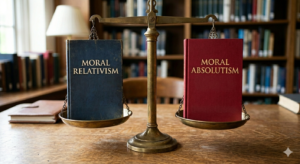 In another section of his book, Moreland questions, “What about an individual that simultaneously is a member of several different societies that may hold different moral values? Such as our nuclear family, our extended family, our neighborhood, school, church, and workplace. Which societies are relevant? What if I am simultaneously a member of two societies and one allows but the other forbids a certain moral action? What do I do in that case?”[2] Both of Moreland’s arguments present the inconsistency or self-refutation of moral relativism.
Another Christian systematic theologian, philosopher, and apologist, Norman L. Geisler (1932-2019), also agreed with the logical self-refutation of moral relativism. In his book, Christian Ethics: Contemporary Issues and Options, Geisler wrote, “Moral relativism is self-defeating, for it makes a universal claim that there are no universal moral truths. If all truth is relative, then the statement ‘all truth is relative’ cannot be absolutely true. Thus, relativism refutes itself.”[3]
In the last article we explored the adverse effects that moral relativism has on our modern culture. For example, it seems this theory lacks logic in many societal responses. Donald Arthur Carson, a Canadian evangelical theologian and distinguished emeritus professor of New Testament at Trinity Evangelical Divinity School and president and co-founder of the Gospel Coalition, wrote, “One of the most disturbing features of contemporary Western culture is the triumph of moral relativism. People increasingly believe that all moral judgments are merely personal or cultural preferences. This stance, however, cannot adequately deal with moral outrage or injustice.”[4] Although many people are drawn to the freedoms of moral relativism, Carson highlights its inability to adequately account for real moral evil when it manifests in the world. The acts of a serial killer, or the rape of a child, are horrific and repulsive to all people, no matter their society or culture.
What is the Biblical Perspective?
The apostle Paul defended the notion that there is a moral code or law that transcends all nations and generations. In other words, moral knowledge is universal, not relative. The apostle Paul wrote, “Indeed, when Gentiles, who do not have the law, do by nature things required by the law, they are a law for themselves, even though they do not have the law. They show that the requirements of the law are written on their hearts, their consciences also bearing witness, and their thoughts sometimes accusing them and at other times even defending them.” (Romans 2:14-15). Paul was explaining in this passage that human conscience reflects a shared moral law and we are all accountable for our behavior, based on one set of moral principles that God has created and implanted in our souls.
 In the Old Testament, the Book of Judges gives us a clear account of how practiced moral relativism resulted in negative consequences in the lives of the Israelites. In Judges 21:24-25, we read, “At that time the Israelites left that place and went home to their tribes and clans, each to his own inheritance. In those days Israel had no king; everyone did as they saw fit.” Later in the Book of Judges, we can read that these Israelites spiraled into a society of violence, injustice, and chaos, causing great harm to themselves and others.
Elsewhere in the Old Testament, the prophet Jeremiah told the Israelites, “This is the covenant I will make with the people of Israel after that time,” declares the Lord. “I will put my law in their minds and write it on their hearts. I will be their God, and they will be my people.” (Jeremiah 31:33). In these verses, the prophet Jeremiah was referring to the Mosaic Law established in the time of Moses, representing God’s absolute moral principles given over 3,500 years ago and still binding for Christians today. There exist many other passages in the Scriptures that speak to the absoluteness of God’s morality, which was established for humanity to follow.
Jesus’ View of Morality
Throughout his earthly ministry, Jesus grounded his moral teachings in the Old Testament. Rather than introducing a new set of moral laws, he expanded the principles already established there. Jesus understood that these moral laws came from God and were to be understood as unchanging. Evidence of this belief can be found in the gospel of Matthew, in a conversation with the disciples where Jesus was explaining to them about end times events to occur in the future. Jesus remarked, “Heaven and earth will pass away, but my words will never pass away.” (Matthew 24:35) Jesus reminded his disciples that his moral teachings were permanent and unchanging, which contrasts with contemporary thinking in our culture that moral ethics and moral rules evolve with time or culture.
This principle of permanence is supported by D. A. Carson, who explains, “The authority of the Lord Jesus stands behind these words (Matt. 24:35): ‘Heaven and earth will pass away, but my words will never pass away.’ This is the same authority of God himself, showing that Jesus’ teachings are to be trusted for all generations.”[5] In his remarks, Carson emphasizes that Jesus’ words are divinely authoritative and enduring, transcending cultures and time.
Jesus claimed to be the way, the truth, and the life (John 14:6). In a direct challenge to relativism, Jesus indirectly declared that truth is not plural or changing but personal and absolute, grounded in Christ himself. Jesus affirms that morality flows from God’s unchanging character, not the desires of humans in their personal or cultural circumstances. Each of Christ’s commands affirms the eternality of God’s Word—a truth he taught throughout his ministry—revealing his view that God’s laws and commands carry absolute moral authority.
Our Response as Christians
How should we respond to our culture’s moral relativism today? As Christians, I believe we must apply these unchanging moral truths in obedience to Christ. We must first recognize that God’s moral law reflects God’s nature; therefore, it cannot be amended by human opinion or social evolution. Morality stands above culture, not within it.
Secondly, God’s moral principles should be used as a foundation for the way we think and act in our culture. For example, when it comes to our civil laws, Jesus desires that we use his moral principles as the foundation for the civil laws we use to govern ourselves. Francis Schaeffer described this combination well in his book, A Christian Manifesto: “The law of God is the only sufficient basis for law, and the state is to be the instrument for carrying out justice in the framework of that law. But within that framework, laws must change as new situations arise.”[6] Applying this to an example in our modern culture, the moral principle to “protect human life” never changes, while the civil laws that express it must adapt to modern realities, whether that involves regulating medical practices, artificial intelligence, or digital privacy.
Critics often point to the differing civil laws among nations and cultures as evidence that moral standards vary from place to place. Yet, if every society built its laws on the same foundational moral truths that God has given mankind, their legal systems would be in harmony and consistent in principle, even if not identical in detail due to differing circumstances within their own cultures.
Thirdly, the same absolute morality must guide every aspect of our lives, including how we interact with friends and enemies, navigate modern cultural norms, respond to technological changes, evaluate what we encounter online, and uphold human dignity, fairness, truth, and responsibility.
Fourthly, we can only succeed in following God’s moral commands by becoming more familiar with his Word and his moral laws. That means spending time reading the Bible and using it to question every instance of questionable behavior we see in our culture. With the same fervor that the Bereans tested the teachings of the apostle Paul (Acts 17:10-12), we need to examine the teachings and beliefs of our modern-day prophets and weigh them against the immutable Word of God to determine its soundness and validity.
Finally, our interpretation of God’s absolute morals should be recognized and valued as a blessing in our lives. We have a Heavenly Father who is a God of love, as confirmed through his nature and his Word. Therefore, we must always recognize that God’s absolute morals have been established to guide us, protect us, bless us, and enrich our lives.
For the complete set of Moral Relativism articles, visit my Library: SeekAndFindGod.org
ENDNOTES
______________________________________________
[1] J. P. Moreland, Love Your God with All Your Mind: The Role of Reason in the Life of the Soul (Colorado Springs, CO: NavPress, 2012).
[2] Ibid.
[3] Norman L. Geisler, Christian Ethics: Contemporary Issues and Options (Grand Rapids, MI: Baker Academic, 2010).
[4] D. A. Carson, The Gagging of God: Christianity Confronts Pluralism (Grand Rapids, MI: Zondervan, 1996).
[5] Carson, D. A. The Expositor’s Bible Commentary, Vol. 8: Matthew and Mark. Grand Rapids: Zondervan, 1984, p. 496.
[6] Francis A. Schaeffer, A Christian Manifesto (Wheaton, IL: Crossway Books, 1981), p. 51.
Pingback: What is Moral Relativism? Article 1 - Seek and Find God