
Before the twentieth century, little was known about the young boy who was an obscure leader of his country. He started his reign around the age of 8 or 9, over 3,300 years ago (c. 1341–1323 BC.) He was unknown to Western civilization, as his name was mentioned in only a few Egyptian archives; that is, until his tomb was discovered on November 4, 1922, by the British archaeologist Howard Carter. His tomb’s remarkable preservation and the thousands of artifacts inside, including the iconic gold funerary mask, made the discovery one of the most significant archaeological finds in history.[i] His name was King Tutankhamun, affectionately called “King Tut.”
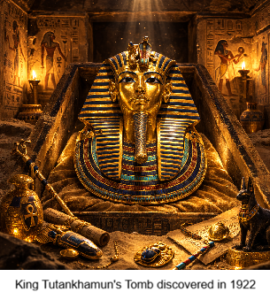 I was fortunate to be able to see King Tutankhamun’s traveling exhibit at the California Science Center in Los Angeles several decades ago. What fascinated me was the power of these archaeological artifacts to transform the life of this young boy from insignificance to a bigger-than-life real historical Egyptian pharaoh.
This is analogous to the understanding we’ve gained through the archaeological discoveries that biblical archaeologists are uncovering to corroborate the historical writings of both the Old and New Testaments.
In the two previous articles of this series, we examined the Bible’s textual preservation and found that Scripture stands as a dependable ancient manuscript, as evaluated by the textual critics. But even though we can agree that the preservation of the Bible’s text has been accurate, it does not guarantee that the Scripture truly reflects what actually happened in history. In this article, we will investigate the archaeologists’ recent archaeological discoveries to determine the Bible’s historical reliability.
Have archaeologists unearthed any major archaeological discoveries supporting the documented biblical accounts?
The Tel Dan Stele
One major archaeological discovery with biblical relevance is The Tel[ii] Dan Stele. This artifact is a fragment of stone, which was erected in the ancient world as a monument. It was created and erected about 870-750 BC and discovered in 1993-1994 at Tel Dan, in northern Israel. 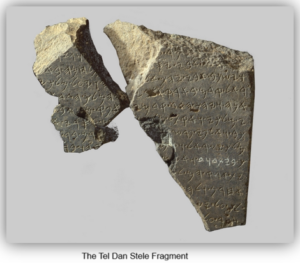 This stele contains the phrase “House of David” (byt dwd), which is widely accepted by scholars as a dynastic reference. It is the earliest known reference to King David other than the Bible. This confirms that King David was not a myth or legend but was recognized as the founder of a royal dynasty.
Furthermore, this stele was written by an opposing king, boasting of defeating Israel and Judah. This find certainly increases the credibility of the historical account. It aligns with biblical accounts of the conflict between Aram, Israel, and Judah described in (2 Kings 8–9). The king who defeated Israel during this period was Hazael, king of Aram-Damascus. Hazael repeatedly attacked Israel and severely weakened it, as recorded in 2 Kings 10:32–33.
Moabite Stone (Mesha Stele)
The Mesha Stele, or Moabite Stone, is one of the most important archaeological discoveries for understanding the historical world of the Old Testament. This stone is a black basalt monument about 3 ½ feet tall and dated around 840 BC. It is inscribed in the Moabite language, which is similar to the Hebrew, and commissioned by the Moab King, Mesha, to commemorate Moab’s victory over the oppression of the Israelites by King Omri. It explains how the Moabites rebelled and regained their independence. This is consistent with the biblical account in 2 Kings 3, which records Moab rebelling after the death of Arab. This monument was discovered in 1868 at Dhiban (ancient Dibon) in modern-day Jordan.
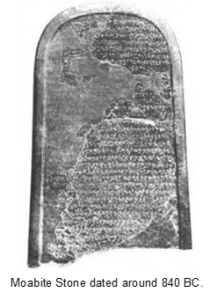 This monument is important because it identifies the name Yahweh, which is the revered name of God to the Israelites. There is also a reference to the “House of David,” referring to David as a former king of Israel. It also identifies the “House of Omri,” the king of Israel during the time of this battle.
This archaeological artifact provides evidence of King David as an actual historical figure during the Old Testament era.[iii] For those of you who are interested in reading the full inscription of the Moabite Stone, I’ve included it as an endnote at the end of this article.[iv]
Other Archaeological Artifacts
The historical narratives and events of the Bible are corroborated by hundreds of archaeological finds that have provided further evidence about the truthfulness of the historical people and events contained in the Bible’s text. I’ve placed a few of the more significant artifact discoveries in the Endnotes section of this article for the reader’s review.[v]
William F. Albright, who was an American archaeologist, biblical scholar, and philologist and considered one of the twentieth century’s most influential American biblical scholars, made this comment: “There can be no doubt that archaeology has confirmed the substantial historicity of Old Testament tradition.”[vi]
Archaeological evidenceAre there any archaeological artifacts discovered that discount the biblical record?
No Archaeological Contradictions
Most archaeological scholars have argued that no discovery related to the Bible has contradicted the biblical text. Dr. Glueck served as president of Hebrew Union College from 1947 until his death in 1971, and his pioneering work in biblical archaeology resulted in the discovery of 1,500 ancient sites. Dr. Glueck wrote the following: “It may be stated categorically that no archeological discovery has ever controverted a single biblical reference. Scores of archaeological findings have been made that confirm in clear outline or in exact detail historical statements in the Bible.”[vii] Even secular television programs like the National Geographic segment titled Lost Kings of the Bible highlight incredible discoveries of artifacts belonging to or referring to biblical people and events once dismissed as fictitious.[viii]
What scholarly criticism rejects the reliability of the Bible from an archaeological perspective?
Biblical Archaeological Criticism
There are a few archaeological scholars that question the reliability of the Bible based on its lack of evidence from discovered artifacts. But a strong counterargument to these critics is represented by William Foxwell Albright, who was an American archaeologist and biblical scholar. He is considered one of the twentieth century’s most influential American biblical scholars. Albright, an originator of “biblical archaeology,” argued that material evidence often substantiated biblical accounts.[ix] Albright recognized that the field of archaeology, although relatively new, has discovered hundreds of artifacts that support a large number of biblical accounts. Archaeology only recently developed into a scientific discipline marked by systematic and rigorous research. Therefore, the lack of archaeological artifacts to support all the biblical events is not a strong argument for questioning Scripture’s reliability.
The science of archaeology truly began in the late 18th and 19th centuries because advances in science, exploration, education, and methodology finally made it possible to study ancient artifacts systematically rather than merely collect them.[x] Given the growing body of archaeological evidence that aligns with various aspects of the biblical texts, it is reasonable to acknowledge the archaeological reliability within the Bible’s historical record.
These archaeological discoveries provide additional evidence for the credibility of the Scripture’s historical worth, but this data in itself does not offer clear evidence for the Bible’s reliability as a pathway to God. In our next article, we will look into the Bible’s prophetic predictions to see if we can find any evidence that supports or refutes the reliability of the Scriptures.
ENDNOTES
[i] Howard Carter, The Tomb of Tut·ankh·Amen, vol. 1 (London: Cassell, 1923), 26–31.
[ii] Tel – is a man-made archaeological mound formed by many centuries of human settlement built one layer on top of another.
[iii] The Moabite Stone. https://en.wikipedia.org/wiki/Mesha_Stele
[iv] K. Lawson Younger Jr., “The Mesha Inscription,” in The Context of Scripture, vol. 2, ed. William W. Hallo (Leiden: Brill, 2000), 137–138.
Translation of the Mesha Stele
- I am Mesha, son of Chemosh[-yatti], king of Moab, the Dibonite.
- My father reigned over Moab thirty years, and I reigned after my father.
- And I made this high place for Chemosh in Qarcho, because he saved me from all the kings
- and because he caused me to look down on all my enemies.
- Omri was king of Israel, and he oppressed Moab many days,
- for Chemosh was angry with his land.
- And his son succeeded him, and he also said, “I will oppress Moab.”
- In my days he said this, but I looked down on him and on his house,
- and Israel has perished forever!
- Omri had taken possession of the land of Medeba,
- and he dwelt there in his days and half the days of his son, forty years;
- but Chemosh restored it in my days.
- And I built Baal-meon and made in it a reservoir,
- and I built Qiryaten.
- The men of Gad had dwelt in the land of Ataroth from of old,
- and the king of Israel had built Ataroth for himself.
- And I fought against the city and captured it.
- And I killed all the people of the city as a sacrifice for Chemosh and for Moab.
- And I brought back from there the altar-hearth of Dodah
- and dragged it before Chemosh in Qerioth.
- And I settled in it the men of Sharon and the men of Maharith.
- And Chemosh said to me, “Go, take Nebo from Israel.”
- So I went by night and fought against it from break of dawn until noon.
- And I captured it and killed all of it—
- seven thousand men and boys, women and girls,
- and female slaves—because I had devoted it to Ashtar-Chemosh.
- And I took from there the vessels of Yahweh,
- and I dragged them before Chemosh.
- And the king of Israel had built Jahaz and dwelt in it
- while he fought against me, but Chemosh drove him out before me.
- And the House of David dwelt in Horonaim. And Chemosh said to me, ‘Go down, fight against Horonaim’ [Reconstructed]
- and I led them up against Jahaz and captured it
- to add it to Dibon.
- I built Qarcho, the wall of the forests and the wall of the citadel.
- And I built its gates, and I built its towers.
- And I built the king’s house, and I made the double reservoir for the spring inside the city.
- And there was no cistern inside the city of Qarcho,
- so I said to all the people, “Make for yourselves each a cistern in his house.”
- And I cut the moat for Qarcho by means of Israelite prisoners.
- I built Aroer, and I made the road in the Arnon.
- I built Beth-bamoth, for it had been destroyed.
- I built Bezer, for it was in ruins.
- And the men of Dibon stood ready in battle formation,
- for all Dibon was obedient.
- And I reigned over a hundred towns which I had added to the land.
- And I built Medeba and Beth-diblathen and Beth-baal-meon,
- and I placed there the flocks of the land.
48–50. [Fragmentary text concerning Horonaim and further military action.]
[v] Significant Artifact Discoveries
Siloam Inscription, 8th century BCE Hebrew text from the water tunnel in Jerusalem, Commemorates the construction of Hezekiah’s Tunnel, matching biblical description (2 Chron. 32:2-4)
Merneptah Stele, Egyptian stele c. 1208 BCE, Mentions “Israel,” the earliest known reference to the people of Israel outside the Bible.
Pilate Stone, 1st-century AD, limestone block found at Caesarea Maritima, Mentions Pontius Pilate, Prefect of Judea, confirming the historical figure in the Gospels.
Caiaphas Ossuary, 1st-century burial box inscribed “Joseph son of Caiaphas”, Ties the high priest Caiaphas (in Gospel accounts) to an archaeological find.
Pool of Siloam (excavated), Pool rediscovered in Jerusalem, Matches the description in John 9 where Jesus heals a man by the pool.
Gallio Inscription, Roman inscription from Delphi, Dates Paul’s ministry by naming the proconsul Gallio (Acts 18:12-17).
[vi] William F. Albright, Archaeology and the Religions of Israel (Baltimore: Johns Hopkins University Press, 1956), 176.
[vii] Nelson Glueck, Rivers in the Desert: A History of the Negev (New York: Farrar, Straus and Cudahy, 1959), 31.
[viii] Lost Kings of the Bible, directed by National Geographic Television, aired on National Geographic Channel, 2011.
[ix] William F. Albright, Archaeology and the Religions of Israel, The Johns Hopkins Press, p.176
[x] Archaeology as a discipline is of fairly recent origin… inadequate scientific techniques and processes were not available (New World Encyclopedia), accessed via New World Encyclopedia, s.v. “Archaeology,” last modified 2025, https://www.newworldencyclopedia.org/entry/Archaeology