
At one time or another, all of us have wondered about the existence of a God. Is there really a God, and if so, what is he like and why did he create us? These and many other related questions have swept across our minds from time to time. On a grander scale, humankind has sought after God since the dawn of civilization with an innate desire to know and worship him. We have evidence that throughout the ages humanity has created beliefs that helped explain God’s existence and his purpose for our lives. Let’s take some time to explore how truthful and reliable that evidence is—and whether it points to the existence of a supernatural Creator.
Before we launch into this intriguing voyage, I think it important to first define a collective understanding of what we mean by the term “God.” After all, how can we search for God’s existence if we don’t have a mutual understanding of who or what we are looking for? In our understanding of reality, we recognize two realms, the natural and supernatural. As humans, we live in the natural realm and are confined to its specific space and time. But if a being created this physical universe, he would not be restricted to it and instead would live outside of it and therefore reside in the supernatural or spiritual realm. Therefore, we cannot prove God’s existence by physical means, which makes this quest challenging, but not impossible.
Humankind’s Search for God
Throughout history, humanity has been driven by an unquenchable curiosity to understand and connect with the divine Being, believed to be our Creator and the source of life’s purpose and meaning. From the earliest records of human history, archaeologists have uncovered evidence across civilizations that bears witness to his enduring search for—and worship of—supernatural deities. Among the earliest civilizations in Mesopotamia, religion was deeply embedded in daily life and seen as powerful, unpredictable beings who controlled natural forces and human fate. In Ancient Egypt, their gods emphasized order, harmony, and the afterlife. In Ancient Greece, their spiritual leaders combined myth, philosophy, and civic ritual in their relationship with their gods. In early ancient India, the Vedic religion practiced ritual sacrifices to many gods. We have ample historical records of man’s quest to seek and worship the gods of ages.
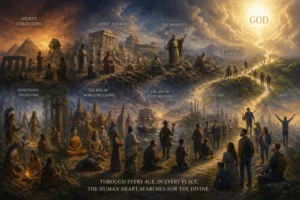
Modern times are no exception. Sociologists and historians readily find evidence of religion and humanity’s ongoing search for God throughout contemporary society. A recent Pew study (2025) surveying 35 countries found that about 83 percent of people across these countries believe in some form of a god, while 17 percent claim not to believe in a god at all.[1] Modern philosophers and religious leaders have suggested human beings possess an inner longing for God, a God-shaped vacuum, that only God Himself can fill, a concept often associated with Blaise Pascal’s reflections on the human condition.[2] Reasoned evidence for God’s existence has emerged from three broad areas of inquiry: philosophy, science, and theology. Let’s take a look at several arguments from each of these fields to see what evidence they possess.
Philosophical Arguments for the Existence of God
The Kalam Cosmological Argument
One of the oldest and most unwavering principles in Western philosophy is the phrase that “out of nothing, nothing comes.”[3] This is the foundation for the following argument that defends God’s existence. Dr. William Lane Craig, in his book, The Kalam Cosmological Argument, states that this philosophical argument is named after the Kalam (medieval Islamic scholasticism) and the Persian Muslim philosopher, Al-Ghazali (c. AD 1058-1111), from whom many of Craig’s key ideas originated.[4] In its most basic form, the Kalam cosmological argument is a philosophical case for God as the cause of the universe and therefore worthy of mention. This cosmological argument rests on three basic principles:
- Whatever begins to exist has a cause. All physical objects and living beings came to be because something caused them. This rule is consistent with our modern scientific principle of cause and effect.
- The universe began to exist. Based on modern science, the universe expanded from a singularity explosion. The universe is winding down and therefore cannot be eternal, based on the second law of thermodynamics.
- Therefore, the universe has a cause. Some being from outside our universe caused the universe to begin. Someone of immense power chose to create our universe. This outside, powerful cause is God.
This is a remarkable and purely philosophical defense for the existence of God and the creation of our universe. Over the course of the last hundred-plus years, mankind has made great advances in astronomy and cosmology to help answer the question about the origin of the universe from a scientific perspective, which we will study in the next article.
The Moral Argument
The moral argument is a philosophical view that the existence of objective and universal moral truths can only exist by something or someone outside of our physical biological realm. For example, if things are truly wrong in the minds of all humanity, regardless of ethnicity, culture, or geography, then these moral injustices must have been established by something transcendent. One form of the argument goes like this:
- If God does not exist, objective moral values do not exist.
- Objective moral values do
- Therefore, God exists.
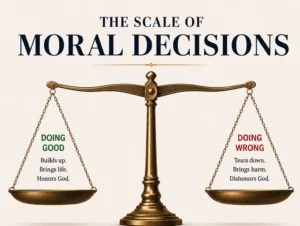
In his book titled Reasonable Faith: Christian Truth and Apologetics, William Lane Craig states, “The moral argument rests on the intuition that objective moral values exist — that torturing children for fun is not merely dispreferred but wrong, regardless of what any culture believes.”[5] Dr. Craig is one of the most contemporary defenders of the moral argument. Craig suggests that something as repulsive as torturing children for fun is despicable in any culture or society and is an accepted universal moral truth that was not established without a supreme being.
The Human Consciousness Argument
Think about this for a moment: where does human consciousness, reason, and self-awareness come from? Supporters of Evolutionary Naturalism claims that nature somehow created itself through trillions and trillions of random iterations of trial and error, which resulted in our enormous universe and all the living beings that reside in it. But this is a purely physical process, one that is restricted to creating new physical entities. So where did man’s ability to reason and engage in self-awareness come from? It is difficult to explain human consciousness and awareness as being created by a purely physical process.
J. P. Moreland, an American philosopher, theologian, and Christian apologist, is an expert in the fields of metaphysics, philosophy of mind, and Christian philosophy. In Moreland’s book titled The Soul: How We Know It’s Real and Why It Matters, he remarks, “The existence of a unified, enduring self that is aware of itself as a subject is not something that falls naturally out of a Darwinian account of the brain. It requires a different kind of explanation entirely.”[6] To describe this another way, for Moreland, the fact that humans possess self-awareness—a capacity to reflect on their own existence—points to a dimension of human nature that is fundamentally immaterial and therefore beyond the reach of any purely biological or evolutionary account. A material evolutionary process cannot account for non-physical capabilities. This can only be explained by an immaterial creator.
Scientific Arguments for the Existence of God
The Fined-Tuned Natural Forces
The universe, in both its governing laws and its natural forms, displays precision so extraordinary as to establish, for many thinkers, a compelling scientific argument for the existence of a designing intelligence. This is a favorable argument for an intelligent designer as a creator and opposes proof for a random series of natural events occurring through some evolutionary process. Scientists and theologians agree on the existence of four identifiable forces and 20 to 30 fundamental constants that appear finely tuned. These four natural forces are the Gravitational Force which governs attraction between masses and shapes galaxies, stars, and planets and allows stable orbits. The Electromagnetic Force, which is responsible for electricity, magnetism, chemistry, light, and atomic structure. The Strong Nuclear Force, which holds protons and neutrons together in atomic nuclei—without it, atoms could not exist—and the Weak Nuclear Force, which is responsible for radioactive decay and nuclear fusion processes in stars.
Some of the more familiar and significant fundamental constants identified include the strength of gravity, the strength of the electromagnetic force, the cosmological constant (dark energy), the speed of light, and the Planck constant. Contemporary scientists have recognized that these forces and constants of nature are very specifically tuned to allow life on earth to be possible. Stephen Hawking, a theoretical physicist & cosmologist, in his book, A Brief History of Time: From the Big Bang to Black Holes, stated, “The laws of science, as we know them at present, contain many fundamental numbers, like the size of the electric charge of the electron and the ratio of the masses of the proton and the electron… The remarkable fact is that the values of these numbers seem to have been very finely adjusted to make possible the development of life.”[7]
John D. Barrow and Frank J. Tipler, a team of cosmologists, also remarked about the finely tuned state of our nature’s forces. In their book, The Anthropic Cosmological Principle, they wrote, “If the electromagnetic force were stronger or the strong nuclear force a little weaker, or both, then biologically essential [atoms] like carbon would not exist. The existence of [life] hinges upon this ‘coincidence.’”[8] The logical conclusion from these fine-tuned physical forces and constants points to some creator to align all of these parameters perfectly to create the universe we live in today.
The Incredible Complexity of DNA
Another fascinating field of research is in the study of the structure of DNA. These molecules are in every organic lifeform on earth and are extremely complex in their design and function and not fully understood. In humans, DNA molecules have the following interesting properties: Every human’s DNA is 99% the same. Only 1% makes us different. Almost every cell in the human body has DNA in its nucleus. Inside that nucleus is your complete genome, or DNA (~3 billion base pairs). This DNA nucleus holds instructions for building and maintaining the human body.
In a lecture a number of years ago, Lee Strobel, who is a Christian author and former investigative journalist, presented an argument for human creation by God as described in the Bible. His rationale was based on the complexity of DNA strand design in our own bodies and every living organism. He stated that every strand of DNA in each of the 60 trillion cells of your body (with the exception of red blood cells) contains all the instructions for creating you. DNA in a cell in your eye is exactly the same as DNA in a cell in your liver or stomach. The difference is which parts of the DNA are active and which are inactive.
A single DNA molecule is 6 feet long but only 50 trillionths of an inch wide. If placed end to end, all the DNA molecules in your body would reach from Earth to the Sun and back 360 times. Evolutionists might be able to present a viable argument for the evolution of matter and energy in our universe from a simpler form into a more complex form, but they have no logical explanation for the evolution of these complex data-driven instructions that provide a master blueprint for building, running, and maintaining every living organism. Such a design can only be explained as originating from a supernatural designer.[9] When skeptics examine DNA instructions, they often view them as the result of random natural processes and chance, not as the product of creative design. The actions of nature can create patterns, but there is no science whatsoever that shows nature can create complex organized information on its own.
A number of scientists who are theistic perceive the creation of DNA in harmony between science and faith, viewing the DNA code as both scientifically real and theologically significant. One such scientist is Francis S. Collins, a physician-scientist who discovered the genes associated with a number of diseases and led the Human Genome Project. Collins remarked in this book, The Language of God: A Scientist Presents Evidence for Belief, “The God of the Bible is also the God of the genome. He can be worshipped in the cathedral or in the laboratory. His creation is majestic, awesome, intricate, and beautiful—and it cannot be at war with itself.”[10]
In our next article, Does God Exist? Article 2 of 2 – God’s Search for Humankind, we will examine the origin of the universe, a highly publicized exploration that once challenged the existence of God. We will also look into several theological arguments from the Bible for God’s existence and discuss why God created us and what God expects from us.
I encourage you to check out my website: seekandfindgod.org to find many other articles that will challenge you to seek more of God and to expand your faith in him.
ENDNOTES
[1] Pew Research Center, “God, Spirits and the Natural World,” May 6, 2025, reporting that a median of 83% across 35 countries say they believe in God, and noting that “large majorities” in most countries hold this belief.
[2] Blaise Pascal, Pensées, trans. A. J. Krailsheimer (London: Penguin Books, 1995), fragment 425.
[3] Lucretius, De Rerum Natura, trans. W. H. D. Rouse, rev. Martin F. Smith (Cambridge, MA: Harvard University Press, 1992), 1.155–156.
[4] William Lane Craig, The Kalām Cosmological Argument (Eugene, OR: Wipf & Stock, 1979)
[5] William Lane Craig, Reasonable Faith: Christian Truth and Apologetics, 3rd ed. (Wheaton, IL: Crossway, 2008), 172.
[6] J. P. Moreland, The Soul: How We Know It’s Real and Why It Matters (Chicago: Moody Publishers, 2014), 89.
[7] Stephen W. Hawking, A Brief History of Time: From the Big Bang to Black Holes (New York: Bantam Books, 1988), 125.
[8] John D. Barrow and Frank J. Tipler, The Anthropic Cosmological Principle (Oxford: Oxford University Press, 1986).
[9] Lee Strobel, Evidence of God from DNA by Lee Strobel.flv, YouTube, Apr 21, 2010, https://www.youtube.com/watch?v=iLCBJLyxxvM
[10] Francis S. Collins, The Language of God: A Scientist Presents Evidence for Belief (New York: Free Press, 2006).