
Welcome back to our final article of Does God Exist? In our first article we observed humankind’s search for God through a number of man-made religions. We also examined several historical, philosophical, and scientific arguments for God’s existence—arguments that remain thought-provoking and genuinely valid. In this article we will continue to study the last of the scientific arguments about the origin of the universe and cover several theological arguments found in the Bible, in the hope of gaining more evidence for God’s existence. We will conclude this paper with a discussion about why God created us and what he expects from us as his creations.
The Origin of the Universe
One of the most compelling arguments for the existence of God is based on recent research in the area of cosmology, which is the study of the nature of the universe. In 1915, Albert Einstein developed his General Theory of Relativity, which suggested the universe was not static. Einstein could not believe the results of his research and consequently modified his equations by inserting a cosmological constant in his equations to fit the accepted static universe model.[1] Einstein would later admit this was the biggest mistake of his life. Years later, in 1929, Edwin Hubble, who was a research astronomer, measured the relationship between the redshift and distance of various galaxies and concluded that the farther galaxies were actually receding away faster than the closer galaxies. This meant that we lived in an expanding universe![2] 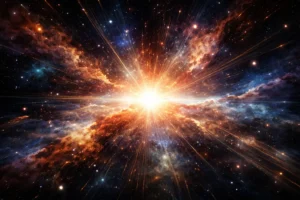 But more significant was the fact that our universe was no longer considered static and eternal but that it had a beginning: a singularity of infinite temperature, density, and pressure. An instantaneous spark that came from nothing created the universe that exists today. This cosmic event has been identified as the Big Bang. It truly is ironic how the tables have turned! I find it interesting that whereas the religious community had found it challenging to argue the existence of God using a static universe model, now the scientific community was challenged to defend how the universe flashed into existence without a God.
Robert Jastrow was a professed agnostic and was director of the Mount Wilson Observatory and founder of NASA’s Goddard Institute of Space Studies. Given his religious position, his theistic quotations are all the more startling. Regarding the overwhelming evidence pointing to the creation of our universe, Jastrow writes, “Now we see how the astronomical evidence leads to a biblical view of the origin of the world. The details differ, but the essential elements in the astronomical and biblical accounts of Genesis are the same: the chain of events leading to man commenced suddenly and sharply at a definite moment in time, in a flash of light and energy.”[3]
Theological Arguments for the Existence of God
The Spiritual Search for God
Isn’t it thought-provoking that people of all cultures, throughout history, have sought after a god that they cannot see or touch? As mentioned earlier, Blaise Pascal, the 17th-century French philosopher and mathematician, was credited with saying that people possess a ‘God-shaped hole’ in their hearts that can only be filled with God. So why do people seek to know a God they cannot see? Spending some time reviewing several biblical references will cast some light on the question. The apostle Paul answered that question in his letter to the Romans when he wrote, “For since the creation of the world God’s invisible qualities—his eternal power and divine nature—have been clearly seen, being understood from what has been made, so that people are without excuse.” (Romans 1:20) The apostle proclaimed that God provided sufficient evidence of his existence, power, and divine nature through the majesty of his creation. When we carefully observe the beauty and precision of our universe and the wonders of life on earth, they unmistakenly point to a supreme being behind it all.
God and Creation Revealed in the Bible
What other references can we find in the Bible that point to God’s existence and his role in creating our universe? We find in the first verse of the first chapter of the Bible, “In the beginning God created the heavens and the earth.” (Genesis 1:1) We can learn from this that the universe has a definite beginning, and God was the initiator of it. In the New Testament, the apostle John wrote, “Through him all things were made; without him nothing was made that has been made.” (John 1:3) This verse also supports the notion that God created everything in our universe. Back in the Old Testament we can find, “By the word of the Lord the heavens were made, their starry host by the breath of his mouth.” (Psalm 33:6) These verses clearly state that the biblical authors recognized God’s existence and affirmed him as the creator of all that the physical world contains. In addition to these verses, the Bible contains many other passages that affirm God as the sole source and creator of the universe.
Humanity’s Moral Imprint
In the previous article, I discussed moral code from a philosophical perspective as an argument for the existence of God. A moral code is a system of principles, values, or rules that distinguishes right and wrong conduct and provides guidelines for how humans are to act. Approached from a spiritual perspective, our inborn morality finds strong support in scripture for the existence of God.
 The apostle Paul defended the notion that there is a moral code that transcends all ethnicities, nationalities, and generations. In other words, moral knowledge is universal and absolute, not relative. The apostle Paul wrote, “Indeed, when Gentiles, who do not have the law, do by nature things required by the law, they are a law for themselves, even though they do not have the law. They show that the requirements of the law are written on their hearts, their consciences also bearing witness, and their thoughts sometimes accusing them and at other times even defending them.” (Romans 2:14-15). Paul was proclaiming that the human conscience reflects a shared moral law, a consequence of a supernatural force imprinting these laws into our very hearts, not physically but spiritually.
The prophet Moses also defended this universal moral code through his statement, “So God created mankind in his own image, in the image of God he created them; male and female he created them.” (Genesis 1:27) Since we were made in his image, God etched his moral nature into our hearts and minds. The fact that all of humanity possesses the same sense of morality (i.e., killing children is wrong, helping others in need is right) is evidence of God creating all of humanity.
The prophet Jeremiah prophesied a similar principle to the Israelites: “This is the covenant I will make with the people of Israel after that time,” declares the Lord. “I will put my law in their minds and write it on their hearts. I will be their God, and they will be my people.” (Jeremiah 31:33). In this passage, the prophet Jeremiah was referring to the Mosaic Law established in the time of Moses, representing God’s absolute moral values possessed by all humankind. Keep in mind that whether individuals choose to follow God’s moral values is determined by people’s God-given free will.
Conclusion
This article has reviewed the question of God’s existence from a number of perspectives, including philosophical, scientific, and theological disciplines. Philosophically, the Kalam argument presents God as a cause of everything created. The moral argument states that because there is a common set of moral values possessed by all of mankind, there must be a creator that implanted them into our minds and hearts. The human consciousness argument presents mankind’s ability to reason and be self-aware, qualities that cannot be explained as created by an evolutionary process alone, and, therefore, this argument supports the notion of a supernatural creator.
In the arena of science, we discovered that the fine-tuned natural forces responsible for the condition of our universe to sustain life are too perfectly adjusted to explain through a non-creator evolutionary process. The amazing complexity of the DNA molecules of all living organisms in our world that contain an enormous number of data-driven instructions to create and sustain these living structures can only be explained by an intelligent being who designed and fabricated these natural systems. The cosmological conclusion that the universe originated in a singularity of infinite energy — what scientists call the Big Bang — points compellingly to a creator who transcends space and time and is responsible for that monumental event.
As we investigated the Bible for God’s existence, we discussed humanity’s drive to search and worship a supernatural being throughout the ages. We read several references from the Bible that make clear God does exist and is the author of our universe. We also examined the moral imprint that is universal throughout mankind and consistent with the notion of a God who was the originator of our moral values. Based on the evidence presented, there is considerable reason to confidently conclude that God exists—a God who created both the universe and humankind. And that conclusion naturally leads us to the next compelling questions: Why did God create us, and what does he expect from us? Let’s look at God’s Word to see what we can find.
Why Did God Create Us?
A careful reading of Scripture discloses the divine purpose for humanity with considerable clarity. First of all, God created us for his glory. God stated, “Everyone who is called by my name, whom I created for my glory, whom I formed and made.” (Isaiah 43:7) Honestly, I don’t fully understand how humans who are sinful can adequately glorify God, but because his Son Jesus died on the cross for our sins, we are righteous in God’s eyes, and as a result, our righteousness glorifies the Father.
In addition, the apostle Paul revealed another aspect of God’s purpose for our creation: “We are God’s handiwork, created in Christ Jesus to do good works, which God prepared in advance for us to do.” (Ephesians 2:10) Therefore, we have a purpose in God’s mind: to complete the good works that God called us to accomplish since the beginning of time. Therefore, we need to seek God’s purpose for our lives to discover what we have been called to do.
Finally, God created us to enjoy an eternal relationship with him. Jesus revealed to his disciples and to us, “I no longer call you servants… Instead, I have called you friends.” (John 15:15). The apostle John in the book of Revelation wrote, “Look! God’s dwelling place is now among the people, and he will dwell with them. They will be his people, and God himself will be with them and be their God. He will wipe every tear from their eyes. There will be no more death or mourning or crying or pain, for the old order of things has passed away.” (Revelation 21:3-4) Also in the book of Revelation, we are reminded, “Those who are victorious will inherit all this, and I will be their God and they will be my children.” (Revelation 21:7) These biblical verses clearly answer our question about why God created us. To glorify him, to do good works for his Kingdom, and to enjoy a deep and intimate relationship with God throughout eternity!
What Does God Expect from Us?
Fortunately, God has clearly revealed what he expects from us through his Word. First, to love him with all our emotions, soul, mind, and body. When asked by an expert of the law which was the greatest commandment, “Jesus replied, “Love the Lord your God with all your heart and with all your soul and with all your mind. This is the first and greatest commandment.”” (Matthew 22:37-38) God wants us completely, all our emotions, all our thoughts, and all our spirit. God’s nature is perfect and is only capable of loving us perfectly, so he wants us to reciprocate with the same intensity. God knows what is best for us, which is perfect love expressed to our God and to others.
Secondly, God wants us to remain obedient to him, not because he desires to control us like robots but as a way of demonstrating our love to him. Jesus said to his disciples, “If you love me, keep my commands.” (John 14:15). Finally, God wants us to believe in him, not exercising a belief that is distant and superficial, but a faith that trusts him completely in every aspect of our lives. Jesus said, “For God so loved the world that he gave his one and only Son, that whoever believes in him shall not perish but have eternal life.” (John 3:16)
God exists, and he has not left us without direction. He has set before us a way of life ordered toward a loving relationship with himself, by which we are conformed to the image of Christ and drawn ever deeper into love, faith, and trust in the one sovereign God who is worthy of all worship and praise. In closing, don’t let this article’s subtitle, “God’s Search for Humankind,” alarm you. God has not lost his creation; instead, he seeks to establish a personal and loving relationship with everyone he has created, hoping that we all will seek to find and love him as well.
I encourage you to check out my website: seekandfindgod.org to find many other articles that will challenge you to seek more of God and to increase your faith in him.
Endnotes
[1] Rugh, S; Zinkernagel, H. (2001). “The Quantum Vacuum and the Cosmological Constant Problem”. Studies in History and Philosophy of Modern Physics. 33 (4): 663–705.
[2] Hubble, Edwin. “A Relation between Distance and Radial Velocity among Extra‑Galactic Nebulae.” Proceedings of the National Academy of Sciences 15, no. 3 (1929): 168–173.
[3] Robert Jastrow, God and the Astronomers, 14. Grand Central Pub, 1980.