
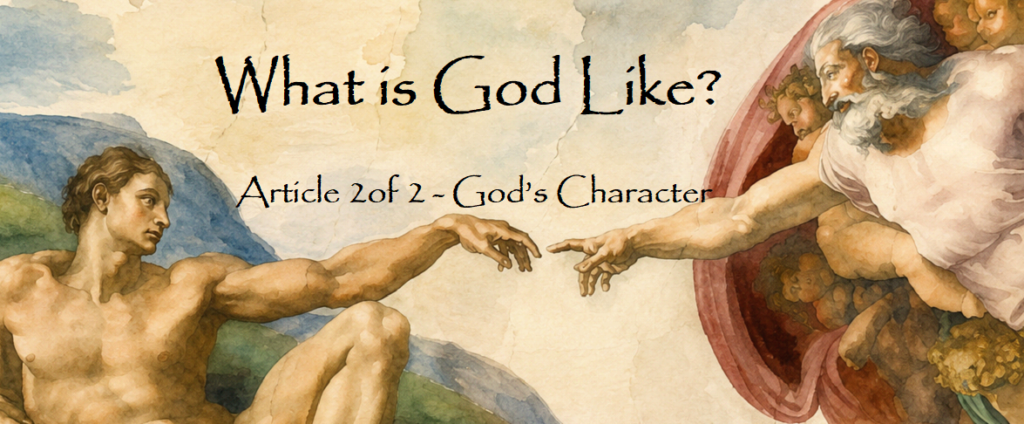
When you think about the character of God, what comes to your mind? Most people center on God’s love, compassion, mercy, and grace. These are attributes humans possess as well, but not to the perfection reflected in God. Amazingly, God has chosen to create us with these communicable[1] characteristics that mirror his own. The first chapter of the Bible speaks of this, as Moses proclaims, “So God created mankind in his own image, in the image of God he created them; male and female he created them.” (Genesis 1:27)
In this article we will explore some of God’s incredible characteristics to better understand who he is and how he responds to humankind. The more we learn about our Lord’s character, the more we can confidently interact with him and grow to love him. This is no different than the way we develop relationships with our family and friends we’ve grown to know, trust, and love. It’s interesting to consider that if we didn’t have some similarity with our creator, then there would be no real way to connect with him relationally, for he would seem so alien to us. God knew this and fortunately chose to create us in his image. This underscores God’s desire to have a deep relationship with each of us.
But there is one important difference between a human’s character and the character of God. Our character is shaped over time, through our childhood experiences, failures, and successes, in addition to our choices and the values we uphold. In fact, it can be said that a person’s character never stops growing throughout their lifetime. On the other hand, God’s character has always been the same and will continue to be the same throughout eternity. In the Bible, God tells us, “I the Lord do not change. So you, the descendants of Jacob, are not destroyed.” (Malachi 3:6) and “Jesus Christ is the same yesterday and today and forever.” (Hebrews 13:8). The permanence of God’s character is a mystery but also a blessing, for he will remain faithful, and we can trust his responses toward us yesterday, today, and tomorrow. Let’s take some time to learn more about our God, discovering his character as revealed in his Word.
God’s Holiness
One of God’s most reverent attributes is his holiness. What is holiness? It can be defined as absolute moral purity and complete separation from sin. In the case of God’s holiness, A.W. Tozer mentions that “God doesn’t conform to a standard of holiness — He is the standard, absolutely and incomprehensibly pure, incapable of being anything other than what he is. He ties this to the doctrine that holiness qualifies every other perfection: because God is holy, everything belonging to his nature must likewise be understood as holy.”[2] Please take a moment to reflect that God’s essence establishes what is holy. Now consider how God’s perfect holiness is reflected on every other attribute of his character as well.
 I believe that is why when the prophet Isaiah was confronted with the holiness of God in a vision, he realized his complete unholiness and cried out, “Woe to me!” I cried. “I am ruined! For I am a man of unclean lips, and I live among a people of unclean lips, and my eyes have seen the King, the Lord Almighty.” (Isaiah 6:1-6). Our Lord’s holiness is not only incomprehensible but unattainable.
We can find many verses in the Bible that describe God’s holiness. God commanded the Israelites and us that “I am the Lord your God; consecrate yourselves and be holy, because I am holy.” (Leviticus 11:44). Elsewhere, the psalmist declares, “Exalt the Lord our God and worship at his holy mountain, for the Lord our God is holy.” (Psalm 99:9) As his creation, we can only marvel at the perfect holiness of our Creator and, in obedience, strive to be like him, however imperfect that likeness may be.
God’s Love
How can we discuss the character of God without including his love? In the same way we discovered that the essence of God is holiness, we learn that the essence of God is love. The apostle John tells us that “God is love” (1 John 4:8). Love cannot be separated from God any more than oxygen atoms can be separated from water. Without oxygen atoms there is no water, and without love there is no God. So, what is the expression of God’s love? That God eternally gives of himself to others. It’s a selfless act of giving for the benefit and blessings of others.[3]
Have you ever pondered how much God loves you? The apostle Paul writes that, “For I am convinced that neither death nor life, neither angels nor demons, neither the present nor the future, nor any powers, neither height nor depth, nor anything else in all creation, will be able to separate us from the love of God that is in Christ Jesus our Lord.” (Romans 8:38-39). So how can we calculate the degree of God’s love? We all know that loving someone requires sacrifice, giving yourself for the good of another person. Now consider the profound love that God has for you, multiplied by everyone throughout history: billions and billions of people. Can you imagine the amount of sacrifice God has made for all of us? This is only possible from an eternally and infinitely loving God. Even though we were condemned because of our sinful nature, “This is how God showed his love among us: He sent his one and only Son into the world that we might live through him. This is love: not that we loved God, but that he loved us and sent his Son as an atoning sacrifice for our sins.” (1 John 4:9-10). It is inconceivable that the Creator of the universe would create humankind, then sacrifice his own Son for our salvation. We can’t begin to fathom that degree of love.
God’s Mercy and Grace
I once heard from a pastor that God’s grace is getting what we don’t deserve, while his mercy is not getting what we do deserve. That simple but powerful phrase never left me, for it helps me to understand the difference between these two attributes. Let’s say, for example, that a person owes a massive debt that they absolutely cannot pay. Mercy on the debtor means he/she is not required to suffer the penalty for non-payment. While grace means someone else will pay the penalty for the debtor, and the debtor receives something that he/she could never earn. Therefore, these two attributes of God are related, but there exists a distinct difference between the two.
Concerning mercy, Grudem suggests that God’s mercy is expressed in his goodness toward those in misery and distress.[4] In the Old Testament, David wrote, “The LORD is merciful and gracious, slow to anger and abounding in steadfast love.” (Psalm 103:8, RSV). Our Lord knows our spiritual loss, misery, and distress, and through his love, extends mercy to his people. As we seek to know and obey God, he forgets our debts and their resulting consequences.
 Regarding God’s grace, Millard J. Erickson, a Christian theologian, professor of theology, and author of Christian Theology, wrote that God’s grace deals with people not on the basis of their merit or worthiness, but simply according to their need; in other words, he deals with them on the basis of his goodness and generosity.[5] God freely gives us this kind of grace, not because we have earned it, but because of His goodness and mercy.
In the Old Testament we learn that the prophet Moses was approached by God on Mount Sinai, and “The Lord passed before him, and proclaimed, “The Lord, the Lord, a God merciful and gracious, slow to anger, and abounding in steadfast love and faithfulness, keeping steadfast love for thousands, forgiving iniquity and transgression and sin…” (Exodus 34:6-7, RSV). God revealed to Moses his character as a gracious and loving God, even to a people who were wicked and rebellious.
So, what does God’s grace look like in our lives? We can identify his grace amply in every facet of our lives, but his greatest gift is stated in the apostle Paul’s writing, “It is by grace you have been saved, through faith—and this is not from yourselves, it is the gift of God—not by works, so that no one can boast.” (Ephesians 2:8-9). It is by God’s grace that we are created, abundantly blessed, and ultimately saved, highlighting the fact that God’s grace offers each of us avoidance of what we deserve and acceptance of what we don’t deserve.
God’s Righteousness and Justice
Understanding God’s righteousness and justice requires a deeper look into the use of these words in the Greek. Whereas the English uses two term families (“righteous” and “justice”), the Greek only employs one term for these two English terms. In other words, there is a much closer interpretation of these terms in Greek and also Hebrew than in the English language. Additionally, “Because the word justification has obtained prominence as a legal term in the English, there is a strong temptation to read juridical connotations into any occurrence of the word in Greek.”[6] One helpful way to understand God’s justice is to see it as that which is inherently fair and unbiased. His righteousness, then—always right by definition—necessarily includes both fairness and equality.
When speaking about God’s attributes of righteousness and justice, Grudem considers these two terms to be one attribute of God as he declares, “God’s righteousness means that God always acts in accordance with what is right and is himself the final standard of what is right”[7] Therefore, when we ask the question, “What is right?”, it is God who determines what is right because by his nature he is the standard of righteousness. Here are just a few biblical verses that address God’s righteousness: “For the Lord is righteous, he loves justice; the upright will see his face.” (Psalm 11:7), and “Righteousness and justice are the foundation of your throne; love and faithfulness go before you.” (Psalm 89:14). These and other verses in scriptures testify to God and his character that are righteous and just.
Now if God is just, it also implies some form of rightful punishment for our sins, for people should receive what they deserve. In fact, all of us have sinned and fallen short of God’s glory.[8] Fortunately our God is also merciful (not giving us what we deserve); therefore, “…all are justified freely by his grace through the redemption that came by Christ Jesus.” (Romans 3:24). The apostle Paul goes on to write, “God presented Christ as a sacrifice of atonement, through the shedding of his blood—to be received by faith. He did this to demonstrate his righteousness, because in his forbearance he had left the sins committed beforehand unpunished—he did it to demonstrate his righteousness at the present time, so as to be just and the one who justifies those who have faith in Jesus.” (Romans 3:25-26) Punishment for our sins still needed to be paid through a perfect sacrifice—one that only His Son, Jesus, could offer by dying on the cross on our behalf.
The Bible addresses dozens of additional attributes of God’s character that go beyond the scope of this article. I encourage you to broaden your understanding of God by investigating more about his character revealed in his Word. In the first article, we explored the incommunicable qualities of God. In this article we’ve discussed some of his communicable qualities, both of which have given us a deeper perception of God’s essence and nature. So, what are we to conclude from this deeper understanding? What can we learn about why God created us and what he expects from us? Let’s look at God’s Word to see what we can find.
Why Did God Create Us?
A careful reading of Scripture discloses the divine purpose for humanity with considerable clarity. First of all, God created us for his glory. God stated, “Everyone who is called by my name, whom I created for my glory, whom I formed and made.” (Isaiah 43:7) Honestly, I don’t fully understand how humans who are sinful can adequately glorify God, but because his Son Jesus died on the cross for our sins, we are righteous in God’s eyes, and as a result, our righteousness glorifies the Father.
In addition, the apostle Paul revealed another aspect of God’s purpose for our creation: “We are God’s handiwork, created in Christ Jesus to do good works, which God prepared in advance for us to do.” (Ephesians 2:10) Therefore, we have a purpose in God’s mind: to complete the good works that God called us to accomplish since the beginning of time. Therefore, we need to seek God’s purpose for our lives to discover what we have been called to do. Additionally, I believe these good works extend beyond our life here on earth into our eternal life with God in heaven.
Finally, God created us to enjoy an eternal relationship with him. Jesus revealed to his disciples and to us, “I no longer call you servants… Instead, I have called you friends.” (John 15:15). The apostle John in the book of Revelation wrote, “Look! God’s dwelling place is now among the people, and he will dwell with them. They will be his people, and God himself will be with them and be their God. He will wipe every tear from their eyes. There will be no more death or mourning or crying or pain, for the old order of things has passed away.” (Revelation 21:3-4) Also in the book of Revelation, we are reminded, “Those who are victorious will inherit all this, and I will be their God and they will be my children.” (Revelation 21:7) These biblical verses clearly answer our question about why God created us. To glorify him, to do good works for his Kingdom, and to enjoy a deep and intimate relationship with God throughout eternity!
What Does God Expect from Us?
Fortunately, God has clearly revealed what he expects from us through his Word. First, to love him with all our emotions, soul, mind, and body. When asked by an expert of the law which was the greatest commandment, “Jesus replied, “Love the Lord your God with all your heart and with all your soul and with all your mind. This is the first and greatest commandment.”” (Matthew 22:37-38). God wants us completely, all our emotions, all our thoughts, and all our spirit. God’s nature is perfect and is only capable of loving us perfectly, so he wants us to reciprocate with the same intensity. God knows what is best for us, which is perfect love expressed to him and to others.
Secondly, God desires our obedience—not because He wishes to control us like puppets, but because He alone knows what is truly best for us, much as loving parents expect obedience from their children. We can also express our love to God through our obedience to him. Jesus said to his disciples, “If you love me, keep my commands.” (John 14:15).
Lastly, God wants us to believe in him, not exercising a belief that is distant and superficial, but a faith that trusts him completely in every aspect of our lives. Jesus said, “For God so loved the world that he gave his one and only Son, that whoever believes in him shall not perish but have eternal life.” (John 3:16). God exists, and in his grace, he has not left us without revelation of himself and his will for our lives. He has set before us a way of life ordered toward a loving relationship with himself, by which we become conformed to the image of Christ and drawn ever deeper into love, faith, and trust in the one sovereign God who is worthy of all worship and praise.
I encourage you to check out my website: seekandfindgod.org to find many other articles that will challenge you to seek more of God and to increase your faith in him.
Endnotes
[1] Communicable attributes are those qualities of God that he has chosen to share with human characteristics.
[2] A.W. Tozer, The Knowledge of the Holy: The Attributes of God and Their Meaning in the Christian Life (New York: Harper & Row, 1961), chap. 12.
[3] Wayne A. Grudem, Systematic Theology, an introduction to biblical doctrine, Zondervan Publishing House, (Grand Rapids, Michigan,1994) Pg. 198.
[4] Wayne A. Grudem, Systematic Theology, an introduction to biblical doctrine, Zondervan Publishing House, (Grand Rapids, Michigan,1994) Pg. 200.
[5] Millard J. Erickson, Christian Theology, second edition (Grand Rapids, Michigan, Baker Books, 2000) Pgs. 320-321.
[6] Ralph P. Martin & Peter H. Davids, Dictionary of the Later New Testament & its Developments, A compendium of Contemporary Biblical Scholarship, (InterVarsity Press, Downers Grove, Illinois, 1997) pg. 1053.
[7] Wayne A. Grudem, Systematic Theology, an introduction to biblical doctrine, Zondervan Publishing House, (Grand Rapids, Michigan,1994) Pg. 203.
[8] Romans 3:23, “…for all have sinned and fall short of the glory of God…”